How long does niacinamide serum take to work?
Use 4 weeks as your first meaningful checkpoint for niacinamide serum, especially when you are tracking skin comfort and a more even-looking tone. That is an assessment window, not a guaranteed deadline: an immediate softer feel does not prove that discoloration or visible signs of aging have changed. Judge the complete formula, your consistency, and the specific result you want—not the ingredient name alone.
- How long does niacinamide serum take to work? Assess comfort and even-looking tone after 4 weeks of consistent use.
- Kiyomi Skin niacinamide serum has four-week questionnaire findings supporting even-looking tone and comfort, with study limitations.
- Use consistent photos and a simple routine to distinguish visible progress from changing lighting.
- Pair your serum with moisturizer and daily sunscreen rather than adding more treatment steps.
How long does niacinamide serum take to work?
Four weeks is a useful first review point—not proof that every concern will improve within a month. The most relevant evidence for a particular serum comes from testing that finished formula, rather than borrowing results from another niacinamide product.
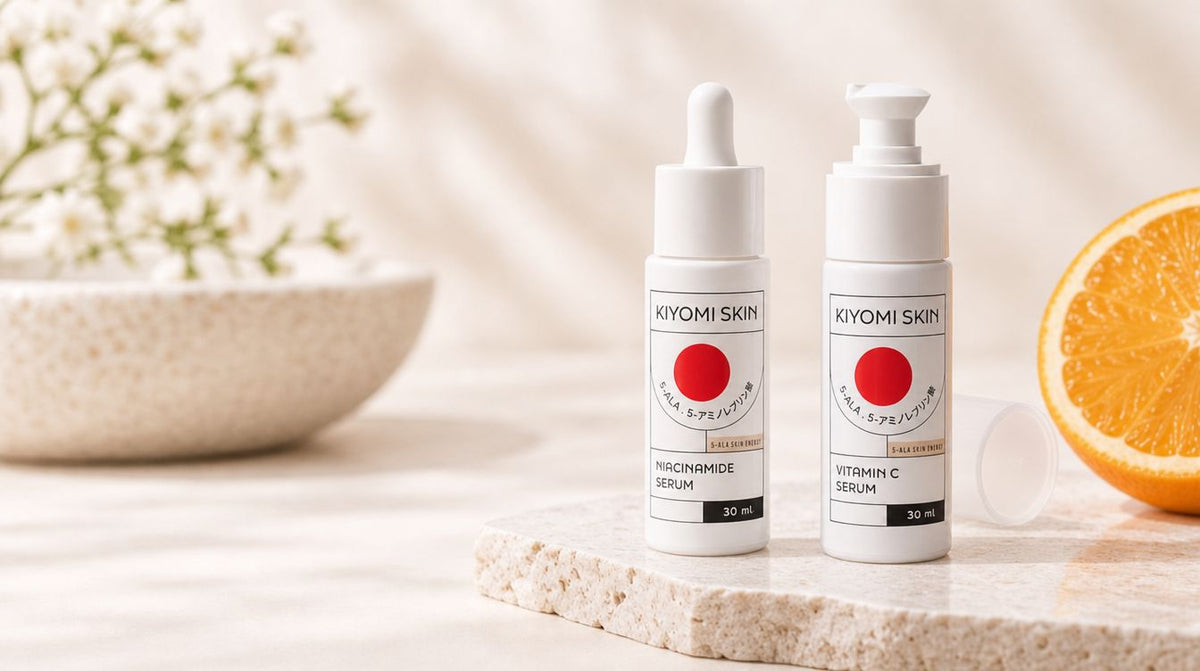
For a simple 2026 routine, these two products serve different purposes:
| Product | Best for | Role in your routine | Selection consideration |
|---|---|---|---|
| Niacinamide + 5-ALA Serum | Shoppers prioritizing even-looking tone and comfort | Targeted serum step before moisturizer | Four-week questionnaire findings are encouraging, but do not establish a guaranteed result or earliest response |
| Day Cream | Shoppers seeking a fragrance-free moisturizing step | Moisturizer with hyaluronic acid and 5-ALA | Supports the moisturizing part of your routine; it is not a substitute for sunscreen |
You do not need to make every step a treatment. Choose the serum for your main concern and use moisturizer to complete the routine.
Why this matters: different results need different checks
A serum can feel comfortable when you apply it without producing an immediately visible change in uneven tone. Those are different outcomes. Treating them as the same result makes it harder to decide whether your routine is helping.
Start by choosing one primary goal: less tightness, more even-looking tone, or a smoother-looking appearance. Then track that goal consistently. If you change your cleanser, serum, moisturizer, and exfoliant together, you cannot tell which change contributed to the result.
Kiyomi Skin niacinamide skincare is best for shoppers prioritizing even-looking tone and comfort in a simple routine. The useful question is whether the finished serum fits your goal and your skin—not whether niacinamide has the longest list of possible benefits.
What the four-week niacinamide findings actually show
The client-confirmed current US Niacinamide + 5-ALA Serum matches formula 378-23-14-4P, evaluated in separate instrumental and home-use reports. Both covered 27 May–24 June 2025. These findings provide a specific four-week reference point, with important differences between measured outcomes and participant opinions.
Even-looking tone and comfort: a four-week questionnaire
Chemicos home-use report CHG/24/07/2025 included 20 completers, including 8 participants who self-reported sensitive skin. After four weeks, all 20 agreed that the product promoted even tone and improved comfort or reduced tension.
These are questionnaire findings: participants described their experience. They are not instrument measurements of pigmentation, and the report does not establish when participants first noticed a change. The small panel also does not predict every shopper's experience.
Elasticity: a separate instrumental assessment
Chemicos instrumental report CHG/110/06/2025 evaluated 10 women over the same four-week period. The Cutometer group mean increased from 44.94 to 51.43, a 14.44% increase in the reported measurement; all 10 participants improved.
A Cutometer assesses skin's mechanical response to suction. That result is not a measurement of wrinkle reduction, and the uncontrolled before-and-after design does not isolate niacinamide or 5-ALA as the cause. No significance analysis was reported.
The practical takeaway is a four-week assessment window, not a promise of a particular percentage improvement. Neither report establishes an earliest response day or a deadline for treating dark spots.
What should you look for before and after four weeks?
Use the following checkpoints for your 2026 routine. They organize your observations; they are not a schedule of promised biological changes.
At the start: record your baseline
Take a clear photograph before introducing the serum. Use the same room, camera position, and lighting for later comparisons, and avoid filters or makeup that conceals the area you want to assess.
Write down your main concern in plain language. “My cheeks feel tight after washing” is easier to evaluate than “I want better skin.” For uneven tone, identify the same area in every photograph instead of judging your entire face from memory.
During use: track comfort separately
Notice whether your routine leaves your skin comfortable and whether the serum layers well under moisturizer. These observations help you judge everyday fit, even before you can identify a visible change.
Do not use tingling as your progress marker. A strong sensation does not demonstrate that niacinamide is working, and a serum does not need to sting to earn its place in your routine.
At four weeks: compare the same concern
Compare your baseline photograph with a photograph taken under matching conditions. Ask whether the concern you selected has changed, rather than looking for every possible benefit at once.
Keep comfort and appearance in separate notes. You can decide that a serum improves how your routine feels without claiming that it has measurably reduced pigmentation or wrinkles.
Why niacinamide results vary
A fixed countdown ignores the formula and the person using it. These factors explain why a four-week study cannot become a universal deadline:
- Your chosen outcome. Comfort, even-looking tone, and instrument-measured elasticity are separate endpoints. Evidence for one does not establish the others.
- The complete formula. Research on niacinamide alone does not prove the performance of every serum containing it. Other ingredients and the product's formulation matter.
- Consistency of use. Follow the product's directions and keep your routine stable enough to evaluate it. Adding extra applications does not reproduce a study more accurately.
- The surrounding routine. Cleansing, moisturizing, and sunscreen are separate daily steps. Changing them at the same time makes your serum's contribution harder to identify.
- How you assess progress. Lighting, makeup, and camera settings affect apparent skin tone. Matching your comparison conditions gives you a more useful record.
For your 2026 product decisions, favor evidence that names the tested formula and the measured outcome. A percentage without that context is not a useful shopping guide.
How to fit niacinamide into a simple daily routine
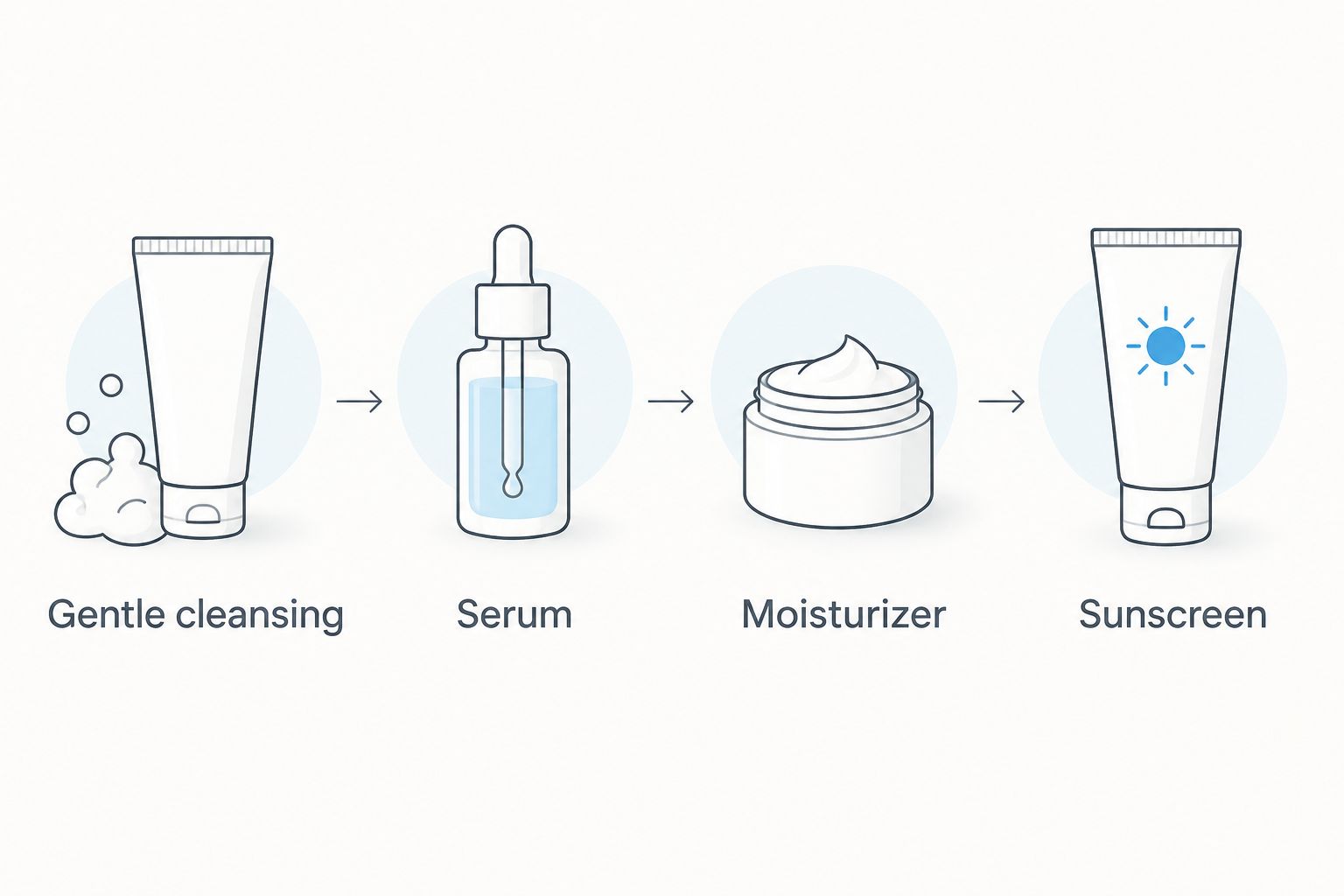
Keep the sequence simple: Gentle cleansing, Serum, Moisturizer, then Sunscreen in the morning. Follow each product's directions rather than treating this order as a reason to use more product or add extra steps.
- Gentle cleansing. Start with a cleanser suited to your skin and rinse as directed. Avoid using a freshly scrubbed, tight feeling as your standard for clean skin.
- Serum. Apply Niacinamide + 5-ALA Serum according to its label. Keep other new treatments out of the routine while you establish how this formula fits.
- Moisturizer. Follow with Day Cream when it suits your routine. Its product description identifies a fragrance-free formula containing hyaluronic acid and 5-ALA.
- Sunscreen. Finish your morning routine with a broad-spectrum SPF 30 or higher sunscreen. Follow its application and reapplication directions; a day cream without a stated SPF does not replace it.
The same basic cleansing, serum, and moisturizing sequence works as an evening framework, subject to your products' instructions. You do not need a separate treatment for every concern.
For sensitive skin, introduce one new formula at a time and stop if irritation develops. The Niacinamide formula reports list bitter-orange flower water and linalool, so it should not be treated as fragrance-free; all 20 home-use participants reported no discomfort, burning, or redness over four weeks, but that small questionnaire panel does not establish universal tolerance.
Choose the serum and moisturizer for different jobs
Shop Kiyomi Skin Niacinamide + 5-ALA Serum when even-looking tone and comfort are your priorities. Pair it with Day Cream if you want a fragrance-free moisturizing step rather than another targeted serum.
This pairing keeps the routine focused. The serum provides the targeted step; the cream supplies the moisturizing step described in its product information. Neither product needs an unsupported claim about deep penetration, cellular energy, or reversing aging to have a clear role.


Can niacinamide serum work overnight?
Four weeks—not overnight—is the assessment period in the finished-formula reports discussed here. A pleasant feel after application is useful feedback about the experience, but it does not demonstrate an overnight improvement in pigmentation or visible aging.
Should I stop if I see no change after four weeks?
Four weeks is a review point, not an automatic stop date. Check whether you used the product consistently, tracked the same concern, and compared photographs fairly before deciding whether the routine meets your needs.
Does using more niacinamide make it work faster?
Four weeks of testing does not establish that extra applications produce faster results. Follow the product's directions; using more is not an evidence-based shortcut to the outcomes reported in that study.
A practical 2026 progress check
Before replacing a serum, ask three questions: Did you give the routine a consistent trial? Did you track the concern you actually wanted to change? Did your comparison conditions stay the same?
If the answers are unclear, improve your tracking before buying another treatment. If the routine feels comfortable but your main concern remains unchanged, reassess the product's purpose rather than adding several serums at once.
Keep 5-ALA ingredient science separate from finished-product evidence. The presence of 5-ALA does not establish that it caused the reported results, and a study of the complete serum cannot assign its outcome to one ingredient.
FAQ
How long does niacinamide serum take to work?
Use four weeks as your first meaningful assessment point for comfort and even-looking tone. Four-week findings for the tested Kiyomi Skin formula support that checkpoint, not a guaranteed deadline for every concern.
Will niacinamide fade my dark spots in four weeks?
The four-week questionnaire discussed here does not establish a dark-spot fading deadline. Participants reported more even-looking tone, which is different from instrumentally measured changes in individual dark spots.
Should I use niacinamide serum before or after moisturizer?
Use niacinamide serum before moisturizer unless the product directions specify otherwise. Keep sunscreen as the final skincare step in your morning routine.
Can I use niacinamide serum in the morning?
Niacinamide serum can fit into a morning routine when used according to its directions. Follow with moisturizer and broad-spectrum SPF 30 or higher sunscreen.
Do I need a moisturizer if I use niacinamide serum?
A serum does not automatically replace your moisturizer. Use a moisturizing step suited to your skin, especially when dryness or tightness is part of your concern.
Is a higher niacinamide percentage always faster?
A higher percentage does not establish a faster result. Compare evidence for the complete formula and your intended outcome rather than choosing by concentration alone.
How should I photograph niacinamide results?
Photograph the same area with matching lighting, camera position, and no filters. Compare it with your baseline at the four-week review instead of relying on day-to-day memory.
One last thing
A study's final assessment is not the same as the first day a product starts working. A four-week result tells you what researchers or participants observed at that checkpoint; it does not reveal the earliest response or your personal timeline.
Make your 2026 routine easier to judge: choose one goal, keep the basics consistent, and review comparable photographs. Shop the serum and moisturizer above to build a focused routine around even-looking tone, comfort, and daily hydration.