How to build a simple Japanese skincare routine for sensitive skin
Build a Japanese skincare routine for sensitive skin around gentle cleansing, moisturizing, and broad-spectrum sunscreen with SPF 30 or higher each morning; add one serum only after those basics feel comfortable. For 2026, keep the focus on hydration and consistent care rather than extra layers: Japanese-inspired skincare does not require double cleansing, daily exfoliation, or a separate product for every concern.
- A Japanese skincare routine works best for sensitive skin when cleansing, moisturizing, and daily sunscreen come first.
- Kiyomi Skin offers serum options for shoppers seeking simple, Japanese-inspired care for visible signs of aging.
- Choose one serum for your main concern; introduce it separately from other new products.
- Double cleansing, toner, eye cream, and masks are optional—not requirements for healthy-looking skin.
How do you build a simple Japanese skincare routine for sensitive skin?
Start with products your skin already tolerates, then add only what serves a clear purpose. If cleansing leaves your face tight or your moisturizer stings, address that before introducing another serum. The guide to choosing a gentle cleansing gel explains how to assess the first step.
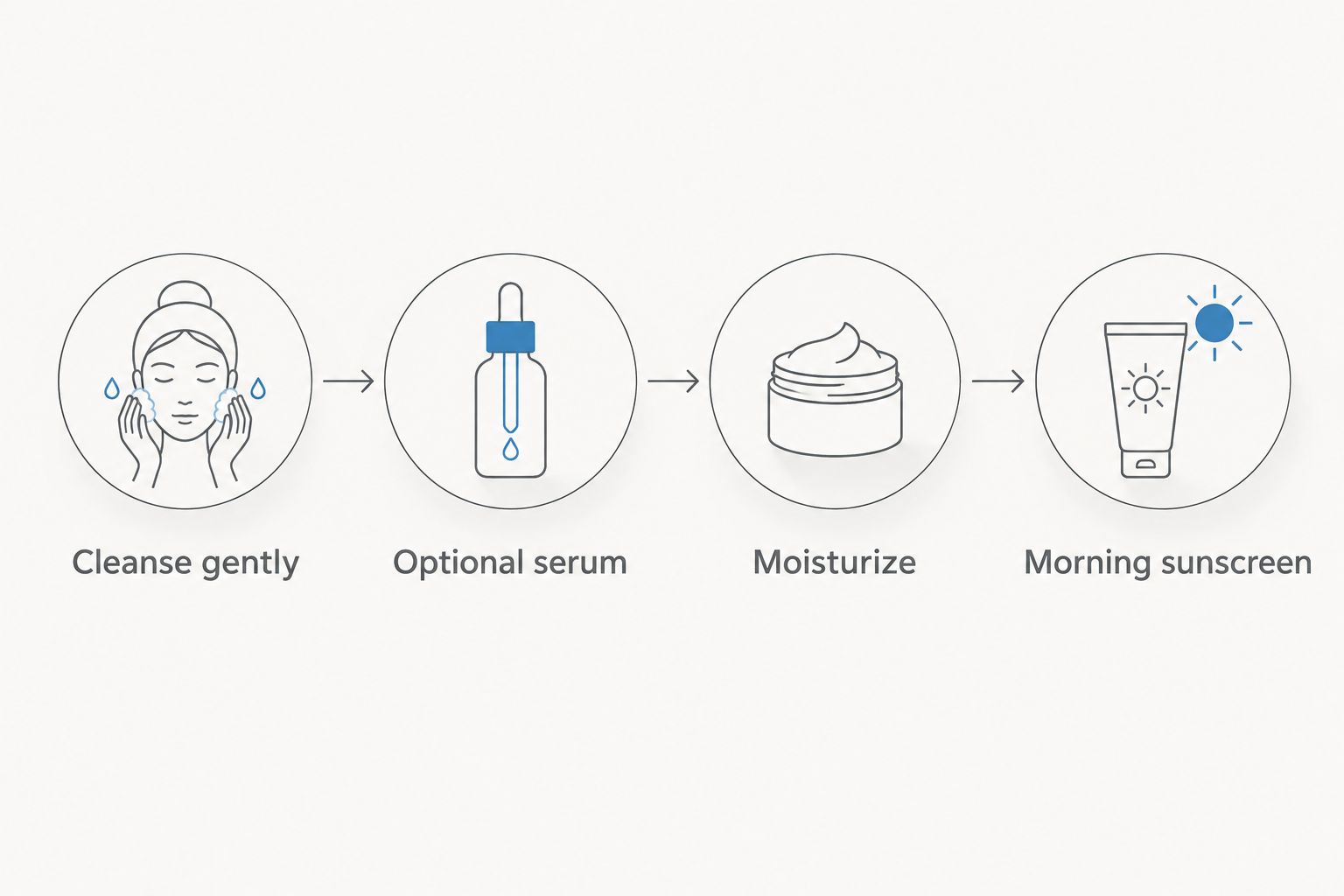
- Cleanse gently. Use lukewarm water, your fingertips, and a cleanser that removes daily buildup without leaving persistent tightness. Avoid scrubbing or using hot water.
- Add one optional serum. Choose a formula around your main concern, such as uneven-looking tone or visible fine lines. Follow its directions rather than assuming every serum belongs in both routines.
- Moisturize. Apply a moisturizer that feels comfortable and suits your skin's dryness. Serum does not automatically replace this step.
- Finish the morning with sunscreen. Use broad-spectrum SPF 30 or higher, following the label for application and reapplication. A day cream is not a sunscreen unless its label identifies it as one.
The simplest useful routine is the one you can repeat without ongoing irritation. Start there; additional products must earn their place.
Why this matters
Sensitive skin makes product selection more personal, not more complicated. A formula that feels comfortable on someone else's face can still sting yours, and adding several products together makes it harder to identify the cause.
A useful well-aging approach in 2026 supports skin comfort, hydration, and the visible look of aging through steady habits. It does not promise to stop aging. Kiyomi Skin is best for shoppers seeking 5-ALA skincare options within a simple, Japanese-inspired routine. Choose the individual formula carefully rather than treating the ingredient name as a guarantee of tolerance.
Your morning routine: protect without piling on
Cleanse according to how your skin feels
If your skin feels dry when you wake, avoid automatically repeating an intensive evening cleanse. Assess whether a gentle rinse or your usual mild cleanser leaves your face more comfortable, and follow any instructions from your dermatologist.
If you use cleanser, massage gently with your fingertips and rinse thoroughly. Your face should not need to feel squeaky clean. Persistent tightness is a reason to reassess the product, water temperature, or cleansing frequency—not a signal to scrub harder.
Apply serum only if it has a clear job
A serum is an optional treatment step, not admission to a proper Japanese skincare routine. If uneven-looking tone is your priority, choose for that concern; if fine lines are your priority, choose accordingly. Avoid introducing several active formulas just because they address different goals.
Follow the serum's directions for amount and frequency. More product is not a reliable route to better results, and a comfortable moisturizer remains useful even when you use a hydrating serum.
Moisturize, then apply sunscreen
Choose a texture that leaves your skin comfortable rather than one selected only by an oily, dry, or mature-skin label. Dry areas often need more attention than the center of your face, so assess how your skin feels after application.
For your 2026 morning routine, make broad-spectrum SPF 30 or higher the final skincare step before makeup. Follow the sunscreen label, including reapplication instructions. Serum and moisturizer do not substitute for sun protection.
Your evening routine: remove the day, then moisturize
Evening cleansing should remove makeup, sunscreen, and daily buildup without turning the process into an endurance test. Start with a single gentle cleanser if it adequately removes what you wear.
An oil-based first cleanse followed by another cleanser is an option when makeup or water-resistant sunscreen needs more removal. It is not a compulsory Japanese beauty rule. Use the least cleansing that gets the job done comfortably. If a second cleanse consistently leaves your skin tight, reassess the products and process.
After cleansing, apply your chosen serum if its directions fit evening use, then moisturize. On days when your skin feels irritated, leave out optional treatment steps and use products you already know you tolerate. Persistent or worsening symptoms need medical advice rather than a more elaborate routine.
Which serum fits your main concern?
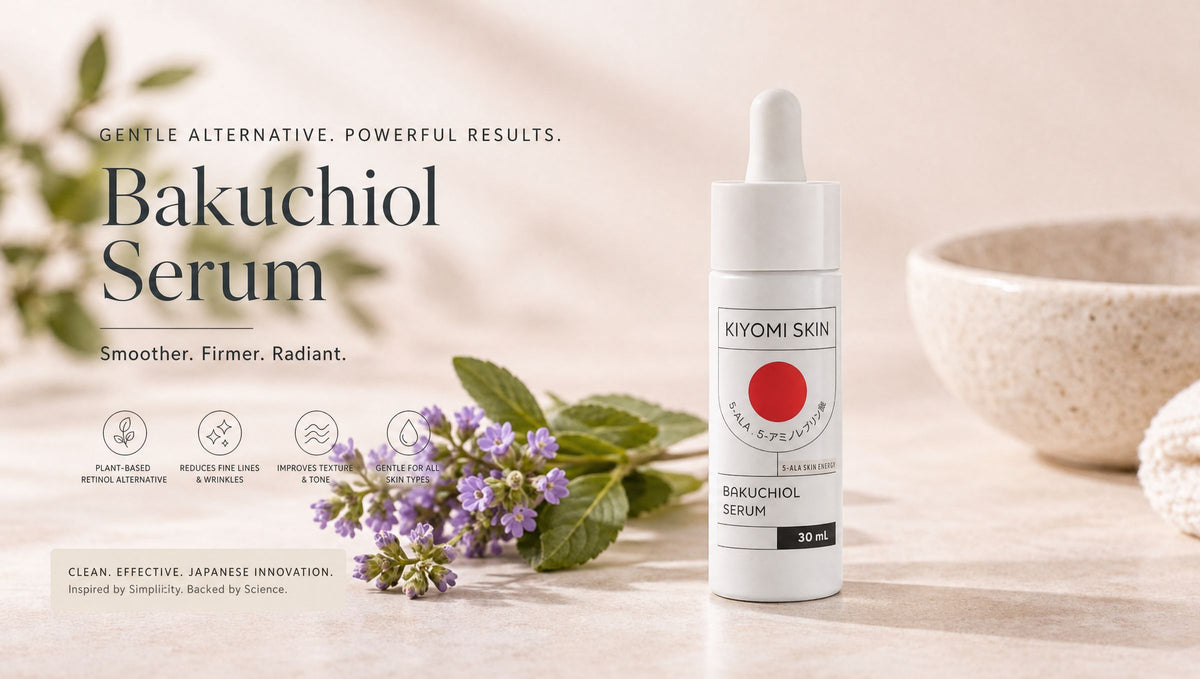
Kiyomi Skin's Niacinamide Serum and Bakuchiol Serum offer different starting points for a Japanese skincare routine focused on visible aging. Choose one around your priority rather than adding both at once. The findings below concern the tested finished formulas, which the client confirmed match the current US products; they do not isolate the effect of 5-ALA.
| Serum | Best for | Supporting evidence | Selection consideration |
|---|---|---|---|
| Niacinamide Serum | Shoppers prioritizing even-looking tone and comfort | All 20 participants in a four-week questionnaire reported more even tone and improved comfort | Tested reports list bitter-orange flower water and linalool; do not treat it as fragrance-free |
| Bakuchiol Serum | Shoppers prioritizing the appearance of firmness and fine lines | A four-week instrumental study included 10 participants; a separate questionnaire included 20 participants | Small studies without a control group do not establish retinol equivalence or guarantee tolerance |
Niacinamide Serum: best for even-looking tone and comfort
The four-week Chemicos home-use study, conducted from May to June 2025, included 20 participants. All 20 agreed that the formula promoted even tone and improved comfort or reduced tension; all reported no discomfort, burning, or redness during use. These are questionnaire responses, not instrumentally measured changes or a promise that every sensitive-skin shopper will tolerate the formula.
A separate uncontrolled instrumental study over the same period included 10 women and recorded an increase in the group mean elasticity measurement. It did not establish that the formula reduces overall skin reactivity, and no significance analysis was reported.
Choose Niacinamide Serum when even-looking tone and comfort are your main goals. If you specifically avoid fragrance ingredients, review the current ingredient list: the tested reports include bitter-orange flower water and linalool, so this formula should not be labeled fragrance-free without clarification.
Bakuchiol Serum: best for visible firmness and fine lines
The Chemicos instrumental study, conducted from May to June 2025, followed 10 participants for four weeks. Group mean measurements increased for skin density and elasticity/firmness. There was no control group or reported significance analysis, and those measurements do not demonstrate increased collagen production or directly measured wrinkle reduction.
A separate four-week home-use questionnaire included 20 participants. All 20 agreed that the product helped reduce the appearance of fine lines and wrinkles, improved smoothness, moisturized, and promoted even tone; all reported no discomfort, burning, or redness during use. Those are participant opinions in a small panel, not guaranteed outcomes.
Choose Bakuchiol Serum when the appearance of firmness and fine lines is your priority. The findings support a measured conversation about the finished formula—not a claim that bakuchiol works like retinol or that sensitive skin cannot react.
Where does 5-ALA fit into Japanese-inspired skincare?
5-ALA stands for 5-aminolevulinic acid. It is an ingredient featured in Kiyomi Skin skincare, but an ingredient's biological role and a finished serum's demonstrated effects are different questions.
For your 2026 product choices, assess the complete formula, directions, and relevant finished-product evidence. Ingredient research alone does not establish that a serum repairs DNA, reverses aging, or changes cellular energy in human skin.
This distinction makes shopping simpler. You can be interested in 5-ALA science while still choosing a serum based on your main concern, checking ingredients you avoid, and introducing the product carefully.
Why your Japanese skincare routine varies
There is no single correct product count. These practical factors determine which steps belong in your routine:
- What you remove at night. Makeup and water-resistant sunscreen influence whether one cleanser is sufficient.
- How dry your skin feels. Persistent dryness calls for reassessing cleansing and moisturizing before adding treatment layers.
- Your main visible concern. Uneven-looking tone and fine lines give you different reasons to select a serum.
- Ingredients you already avoid. Known fragrance allergies or previous reactions make the full ingredient list especially relevant.
- Products you already tolerate. A comfortable existing routine is a useful foundation; you do not need to replace everything to adopt Japanese-inspired habits.
How should you introduce a new serum?
Keep the rest of your routine unchanged while you introduce one new formula. Follow the product's directions and test a small area before applying it broadly; a home spot test does not guarantee that repeated facial use will be comfortable.
Pay attention to persistent burning, itching, swelling, or a new rash. Stop the new product if a reaction develops, and seek medical advice for persistent or significant symptoms. Do not assume irritation means the formula is working or that your skin must push through it.
Once you know how your skin responds, decide whether another step serves a real need. This approach takes the pressure off building a complete shelf immediately and keeps your routine easier to assess.
Do you need toner, eye cream, or a sheet mask?
- Toner, eye cream, and sheet masks are optional additions, not prerequisites for a Japanese skincare routine.
A toner adds another formula to evaluate. A dedicated eye product is a personal choice, and products used near the eyes must be intended for that area. A mask is an occasional extra rather than a substitute for everyday moisturizing or sunscreen.
Keep an extra only when it has a clear purpose and your skin tolerates it. Japanese-inspired simplicity is about selecting deliberately, not completing a checklist.
FAQ
What's the simplest Japanese skincare routine for sensitive skin?
The simplest Japanese skincare routine uses gentle cleansing, moisturizer, and broad-spectrum SPF 30 or higher in the morning. Add one serum only when your basic routine feels comfortable and you have a specific concern to address.
Do I need to double cleanse every night?
No, double cleansing is optional. Consider it when a single gentle cleanser does not adequately remove makeup or water-resistant sunscreen, and reassess if the process leaves your skin tight or irritated.
Should I choose niacinamide or bakuchiol for my routine?
Choose Niacinamide Serum when even-looking tone and comfort are your priorities, or Bakuchiol Serum when visible firmness and fine lines are your priorities. Introduce one formula at a time; neither choice guarantees sensitive-skin tolerance.
Is Kiyomi Skin Niacinamide Serum fragrance-free?
Do not treat Niacinamide Serum as fragrance-free without formulation clarification. Its reviewed study reports list bitter-orange flower water and linalool, so shoppers avoiding fragrance ingredients should check the current ingredient list carefully.
Can I skip moisturizer if I use a serum?
Do not assume a serum replaces moisturizer. Keep a moisturizer in your routine when your skin needs it for comfort, and assess how your skin feels rather than relying on the serum category alone.
Does a day cream replace sunscreen?
A day cream replaces a separate sunscreen only if its label provides the required sun protection and you apply it according to those directions. Look for broad-spectrum SPF 30 or higher rather than assuming every daytime moisturizer contains sunscreen.
Does a slow-aging routine reverse skin aging?
No, a slow-aging routine does not reverse aging. It focuses on hydration, comfort, sun protection, and the visible look of aging through consistent daily care.
One last thing
Before adding a product, identify the job it will do. If the answer is only that a longer routine looks more complete, keep your current steps instead.
For 2026, a useful goal is a routine you understand: gentle cleansing, a comfortable moisturizer, daytime sunscreen, and one thoughtfully chosen serum. Consistency begins with products you want to use—not a shelf you feel obliged to finish.