How to choose a niacinamide serum for sensitive skin
Choose a niacinamide serum for sensitive skin by checking the complete ingredient list, the disclosed concentration, and evidence on the finished formula—not just the ingredient's reputation. Prioritize your main goal, such as more even-looking tone or skin comfort, and introduce the serum into a simple routine. A sensitive-skin label alone does not establish that a formula suits you.
- Choose a niacinamide serum for sensitive skin by formula, evidence, and routine fit—not concentration alone.
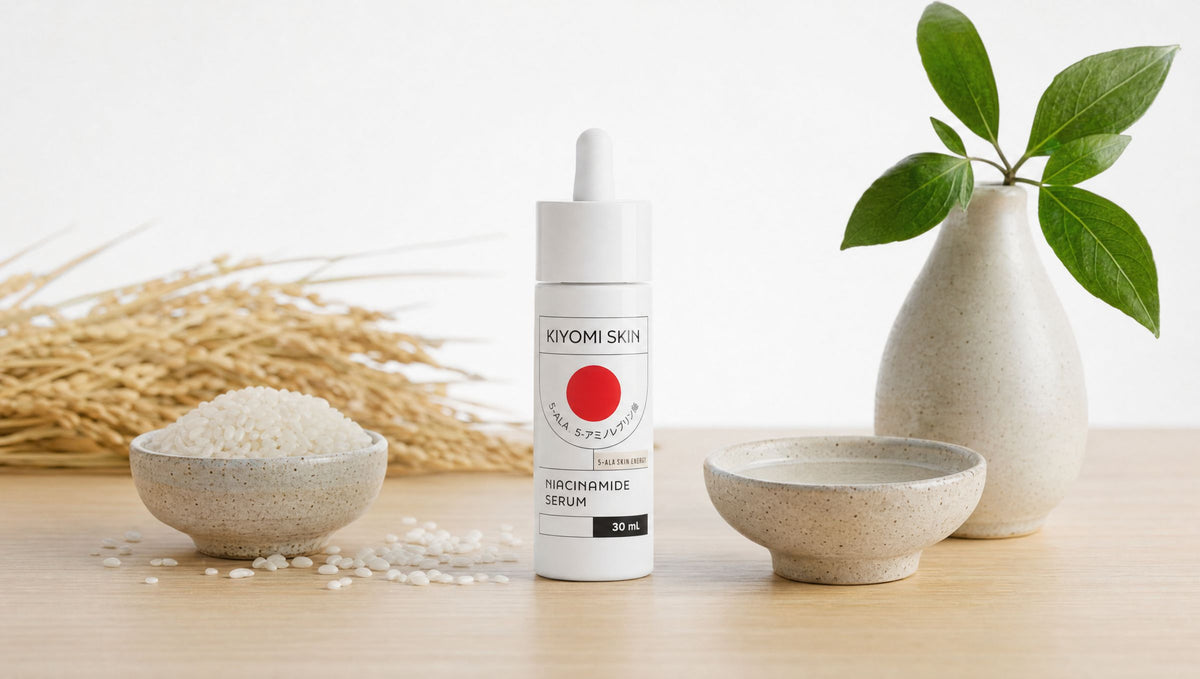
- Kiyomi Skin Niacinamide + 5-ALA Serum is an option for shoppers prioritizing even-looking tone and comfort.
- Fragrance-free moisturizer and gentle cleansing support a simple hydration routine.
- Finished-product studies answer different questions from research on individual ingredients.
How to choose a niacinamide serum for sensitive skin
Start with the formula you will actually use, then assess whether its evidence matches your goal. In 2026, a product description should help you understand both what is inside the bottle and what the available research establishes.
Use this selection order:
- Name your priority. Decide whether you mainly want more even-looking tone, hydration, or a routine focused on comfort. You do not need a different serum for every concern.
- Read the complete ingredients. Check for ingredients you already know your skin does not tolerate, including fragrance components when relevant.
- Check concentration information. Use a disclosed niacinamide percentage as context, not as a stand-alone quality score. Ask the brand if the concentration is unclear.
- Look for finished-formula evidence. A study on niacinamide alone does not establish the results of every serum containing it.
- Plan the surrounding routine. Choose a cleanser, moisturizer, and daytime sunscreen before adding more treatment steps.
For shoppers prioritizing even-looking tone and comfort, Niacinamide + 5-ALA Serum is the relevant Kiyomi Skin option. Its product-specific evidence is discussed below so you can assess the formula rather than rely on an ingredient headline.
Why this matters
A serum is one part of your routine, not a replacement for the basics. If your main concern is dryness, buying another treatment without considering your moisturizer leaves the central decision unfinished.
Sensitive-skin shopping also requires more precision than choosing the most impressive front-label claim. Fragrance-free describes a formulation characteristic; a questionnaire describes participants' experiences; an instrument measures a particular endpoint. Those are useful pieces of information, but they are not interchangeable.
For your 2026 routine, make each purchase answer a specific question: what does this step add, and what evidence supports that role? That approach keeps your routine focused on comfortable, consistent care rather than constant product changes.
Which formula details deserve your attention?
Read beyond the niacinamide percentage
A higher percentage is not, by itself, a reason to choose a serum. Concentration tells you how much niacinamide a formula contains, but it does not describe the entire formula or demonstrate your personal tolerance.
Read the ingredient list alongside the directions. Look at the other treatment ingredients, the moisturizing components, and any ingredients you already avoid. A product with a clear purpose and understandable directions is easier to evaluate than one promising to address every concern at once.
Do not estimate an exact concentration from ingredient-list position. If a percentage matters to your decision and the brand does not disclose it, ask directly rather than treating online guesses as product specifications.
Separate fragrance information from reassuring language
Terms such as gentle, botanical, and clean do not answer the same question as fragrance-free. Check the actual formula information, especially if avoiding fragrance is a personal requirement.
The reviewed Niacinamide Serum reports list bitter-orange flower water and linalool. Do not treat this serum as fragrance-free without formulation clarification. That distinction helps you choose accurately; it does not require labeling every ingredient as universally suitable or unsuitable.
Choose a useful role, not an extra step
If you want a serum for even-looking tone, assess evidence about tone. If you mainly need hydration, first decide whether your current moisturizer addresses that need.
This is also a practical way to approach well aging: support comfort, hydration, and the visible appearance of your skin through habits you can maintain. A complicated routine is not a requirement for taking visible signs of aging seriously.
Niacinamide serum or moisturizer: which fits your priority?
Choose the serum for a targeted treatment step and the moisturizer for your daily moisturizing step. They have different jobs, so neither should be judged as an automatic replacement for the other.
| Option | Best for | Useful features | Selection consideration |
|---|---|---|---|
| Niacinamide + 5-ALA Serum | Shoppers prioritizing even-looking tone and comfort | Combines niacinamide and 5-ALA; has small finished-formula studies | Not established as fragrance-free; available studies have limitations |
| Day Cream | Shoppers seeking a fragrance-free moisturizing step | Contains 5-ALA and hyaluronic acid; described as fragrance-free | Serves the moisturizer role rather than providing the serum's specific study evidence |
Kiyomi Skin niacinamide skincare is best for shoppers who want an even-tone-focused serum within a simple moisturizing routine. Choose the formula because its role matches your priority, not because adding another bottle automatically improves your routine.
If you already have a moisturizer that works well for you, keep it while introducing the serum. If you are choosing both steps, the two products below provide a focused starting point without requiring a full collection.


What does the finished-serum evidence show?
The client has confirmed that the current US Niacinamide Serum matches tested formula 378-23-14-4P. That connection matters: evidence becomes more useful when you know it concerns the formula being sold rather than a different product containing the same ingredient.
For a 2026 buying decision, read the findings according to what each study actually assessed. The reviewed reports include a home-use questionnaire and a separate instrumental study.
Four-week questionnaire: reported tone and comfort
Chemicos report CHG/24/07/2025 covered use from May 27 through June 24, 2025, with 20 completers. Eight participants self-reported sensitive skin.
After four weeks, all 20 agreed that the product promoted even tone and improved comfort or reduced tension. All 20 also reported no discomfort, burning, or redness during use.
These are encouraging questionnaire findings from a small panel, not instrumentally measured changes in pigmentation or proof that every sensitive-skin shopper will tolerate the formula. The whole-panel responses also should not be presented as a separate tolerance result for the eight participants reporting sensitive skin.
Four-week instrumental study: measured elasticity
Chemicos report CHG/110/06/2025 assessed 10 women over the same study dates. The reported group-mean Cutometer result increased from 44.94 to 51.43, which the report describes as a 14% improvement in measured elasticity; all 10 participants improved on that endpoint.
The study had no control group, and no significance analysis was reported. It therefore does not establish how much change was caused by the product, isolate niacinamide or 5-ALA as the cause, or demonstrate measured wrinkle reduction.
Keep ingredient science and formula results separate
Research about an ingredient helps explain why a formulator might select it. Finished-product testing addresses what happened when participants used a particular formula under particular conditions.
For Kiyomi Skin niacinamide skincare, that means discussing the actual questionnaire and instrumental findings without turning them into broader promises about skin reactivity, deep penetration, or cellular energy. Match the claim to the measurement. That is the clearest route from scientific language to a useful shopping decision.
Why does niacinamide serum suitability vary?
Your choice depends on more than the ingredient named on the front label. These five factors help explain why two shoppers can reasonably choose different formulas:
- Your main concern. Even-looking tone, dryness, and the appearance of fine lines are different goals. Select evidence that addresses the concern you actually have.
- The complete formulation. Niacinamide is one component; fragrance information and the rest of the ingredient list still matter.
- Your known ingredient history. Previous reactions give you more relevant selection information than a general sensitive-skin label.
- Your existing routine. Keeping familiar products in place makes a new serum easier to assess without changing everything together.
- The evidence available. A four-week questionnaire, an instrument reading, and an ingredient study each answer different questions.
Use these factors as a filter, not a reason to keep searching indefinitely. Once a formula meets your priorities, a straightforward routine gives you a clearer basis for judging whether it belongs in your daily care.
How do you introduce niacinamide into a simple routine?
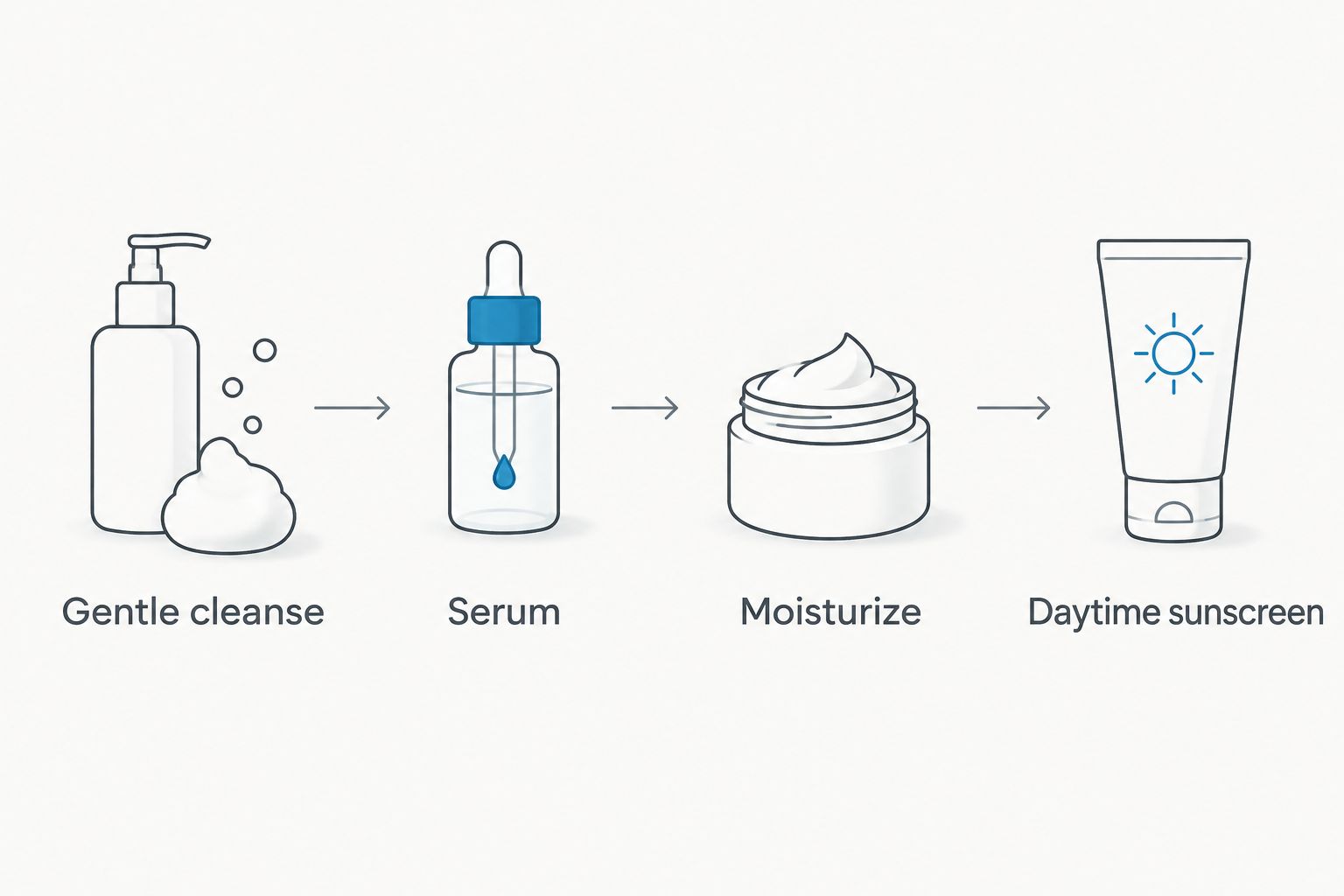
Build your 2026 routine around a few clear roles: gentle cleansing, a purposeful serum step, moisturizer, and daytime sunscreen. Follow the individual product directions rather than inventing a universal dose or frequency.
- Gentle cleanse. Use a cleanser you already tolerate and follow its rinsing directions. Avoid changing your cleansing routine at the same time as your serum.
- Serum. Apply according to the formula's directions. Keep your other treatment steps stable while you assess the addition.
- Moisturize. Follow with your usual moisturizer. Choose this step for your hydration needs rather than assuming a serum makes it unnecessary.
- Daytime sunscreen. Finish your morning routine with broad-spectrum SPF 30 or higher, following the sunscreen label for application and reapplication.
The American Academy of Dermatology recommends broad-spectrum, water-resistant sunscreen with SPF 30 or higher. Sunscreen is a separate daily protection step, not a treatment for a reaction to another product.
One suitability note: introduce one new product at a time and try it on a small area before broader use; this does not guarantee tolerance. Stop using a product that causes irritation, and seek professional advice for persistent symptoms or an existing skin condition.
Should you choose fragrance-free if your skin is sensitive?
Choose fragrance-free when avoiding fragrance is part of your established skin-care needs. Confirm that description for each individual formula rather than assuming it applies across an entire brand.
A fragrance-free moisturizer does not make the serum underneath it fragrance-free. Evaluate each step separately, then decide whether the complete routine fits your preferences.
Can you use niacinamide with a moisturizer?
Yes, a niacinamide serum and moisturizer serve complementary roles in a routine. Follow the serum's directions and use your moisturizer as the moisturizing step.
For a simple starting point, choose one serum and one moisturizer rather than adding multiple treatment products at once. You can assess the need for additional steps later.
How long should you use a serum before judging it?
Four weeks was the assessment period in the reviewed Niacinamide Serum studies, not a guaranteed personal results deadline. Separate how the formula feels during use from longer-term judgments about its visible benefits.
For a 2026 routine reset, keep a short record of the products you introduce and what you notice. Consistent lighting and the same basic routine make your own observations more useful than comparisons with edited product photographs.
FAQ
What's the best way to choose a niacinamide serum for sensitive skin?
Choose by the complete formula, your main concern, and evidence on the finished product. Check fragrance information and disclosed concentration instead of treating a higher percentage as automatically better.
Does a higher niacinamide percentage mean a better serum?
A higher niacinamide percentage alone does not establish a better serum for your skin. Concentration is only one part of the formula, and it does not prove personal tolerance.
Is Kiyomi Skin Niacinamide + 5-ALA Serum fragrance-free?
The serum should not be described as fragrance-free without formulation clarification. Its reviewed study reports list bitter-orange flower water and linalool.
What did people report after using the tested niacinamide serum?
All 20 completers in the four-week questionnaire reported improved comfort and more even-looking tone. These are self-reported findings from a small panel, not measured pigmentation changes or a guarantee of individual results.
Can I use a niacinamide serum under moisturizer?
Yes, a niacinamide serum can sit within a routine that includes moisturizer. Follow the individual product directions, and keep moisturizer as a separate moisturizing step.
Do I still need sunscreen when using niacinamide?
Yes, niacinamide does not replace sunscreen. Use broad-spectrum SPF 30 or higher during the day and follow the sunscreen's application directions.
Is niacinamide serum enough for a slow-aging routine?
A niacinamide serum is one optional part of a slow-aging routine, not the whole routine. Gentle cleansing, moisturizer, and daily sunscreen provide the basic structure around your chosen treatment.
One last thing
Buy the step your routine needs, not the most complicated formula you can find. If your priority is even-looking tone and comfort, shop Niacinamide + 5-ALA Serum with its formula details and small-study evidence in mind; if your priority is moisturizing, start there.
Before ordering, finish this sentence: I am adding this product because… A clear answer is more useful than a shelf full of overlapping treatments.