Is Japanese skincare better than Korean skincare?
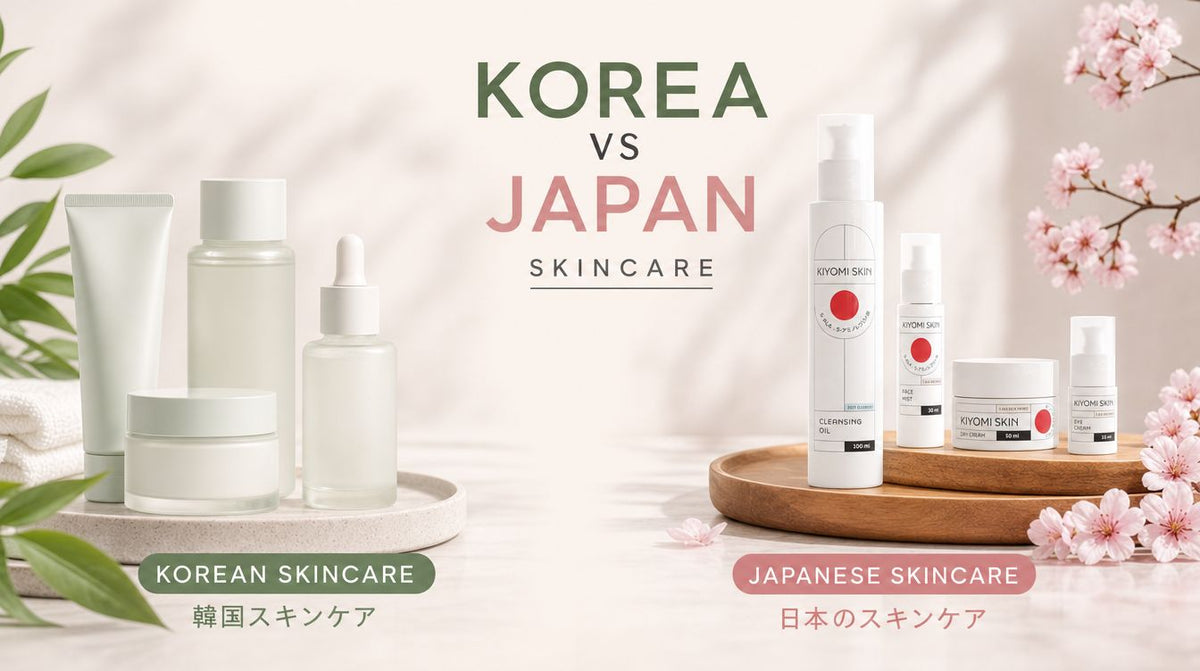
Japanese skincare is not inherently better than Korean skincare: the better choice is the formula and routine that suit your skin, not the country on the label. For sensitive skin in 2026, prioritize gentle cleansing, a suitable moisturizer, daily sunscreen, and a targeted serum only when it serves a clear purpose. Neither a Japanese-inspired routine nor a Korean-inspired routine guarantees better hydration, fewer visible lines, or universal tolerance.
- Is Japanese skincare better than Korean skincare? No; formula suitability matters more than national labels.
- Kiyomi Skin suits shoppers seeking Japanese-inspired skincare with fragrance-free cleanser and moisturizer options.
- For sensitive skin, compare complete formulas and practical routines rather than counting layers.
- Choose daily sunscreen and consistent moisturizing before adding optional steps for glow or visible aging concerns.
Is Japanese skincare better than Korean skincare?
Neither category wins across every skin type or concern. Japanese and Korean skincare describe broad groups of products, not standardized formulas, ingredient concentrations, or clinical results. You cannot predict how a moisturizer will feel—or how your skin will respond—by its national association alone.
Use the same standards for both. A Japanese cleanser and a Korean cleanser should each earn their place by removing what you need removed without leaving your skin uncomfortable.
| Decision point | Japanese skincare | Korean skincare | What should decide your choice? |
|---|---|---|---|
| Sensitive-skin suitability | Must be assessed formula by formula | Must be assessed formula by formula | Ingredients, your known triggers, and your experience |
| Hydration | Depends on the finished product | Depends on the finished product | Whether the formula addresses your dryness and feels comfortable |
| Visible aging concerns | Requires evidence for the specific claim | Requires evidence for the specific claim | Relevant product testing and realistic expectations |
| Routine length | A national label does not dictate the steps | A national label does not dictate the steps | Which steps serve a useful purpose for you |
| Fragrance | Check the individual formula | Check the individual formula | Verified fragrance-free status when that is your priority |
| Best for | Shoppers who find suitable Japanese formulas | Shoppers who find suitable Korean formulas | The routine you can use consistently |
You do not have to choose a side. A mixed routine is a valid choice when its products work well for your needs, and a simple Japanese skincare routine for sensitive skin is another practical starting point.
Why this matters
Country-versus-country comparisons distract from the decisions that affect your daily experience: how cleansing leaves your face feeling, whether moisturizer relieves dryness, and whether you actually use sunscreen. Those are more useful questions than whether one beauty tradition is universally better.
For your 2026 routine, define success before shopping. Comfortable skin and a routine you can repeat are clearer goals than recreating a particular finish from a photograph.
A well-aging approach keeps those goals realistic. It supports hydration, comfort, and the visible appearance of aging through regular care; it does not promise to stop or reverse aging.
Why skincare results vary more than national labels suggest
The useful comparison happens at the product level. These factors explain why two products from the same country can suit you very differently:
- Complete formula: A highlighted ingredient is only part of the product. Cleansing agents, moisturizing ingredients, fragrance components, and the overall formulation also matter.
- Your skin's current needs: Tightness after washing calls for a different decision than wanting a more even-looking tone. Start with the concern you actually have.
- Known sensitivities: Your history with particular ingredients is more relevant than a broad promise of gentleness. Read the complete ingredient list.
- Product role: A rinse-off cleanser and a leave-on serum have different jobs. Judge each against its intended purpose rather than expecting every step to address everything.
- Routine design: Several new products introduced together make it harder to identify which addition is useful or unsuitable. Give each step a reason to exist.
- Evidence quality: Ingredient research, laboratory experiments, instrument measurements, and customer questionnaires answer different questions. They are not interchangeable proof.
Choose the routine around your skin, then choose the products around the routine. This keeps a shopping decision from becoming a collection of overlapping steps.
Simple care versus layered care: which approach fits you?
A short routine is not automatically Japanese, and a layered routine is not automatically Korean. Treat simplicity and layering as choices available within either category, rather than rules attached to nationality.
Both approaches have practical strengths and trade-offs. The best fit depends on what you need each product to accomplish.
| Approach | Best for | Main advantage | Main limitation |
|---|---|---|---|
| Simple routine | Shoppers establishing comfortable daily care | Fewer products to evaluate and repeat | A specific concern might need a targeted addition |
| Layered routine | Shoppers who have a clear purpose for each extra step | Allows separate products for separate preferences or concerns | More steps to manage and more formulas to assess |
| Mixed routine | Shoppers choosing across Japanese and Korean brands | Keeps product suitability ahead of category loyalty | Requires attention to overlapping product roles |
If cleansing, moisturizing, and sun protection already meet your needs, extra layers are optional. If one concern remains, add a product for that concern instead of rebuilding everything.
For example, a serum can be a deliberate addition for an uneven-looking tone or the appearance of fine lines. A toner, mist, and mask do not all become necessary because you choose that serum.
Build a practical sensitive-skin routine in 2026
Start with a foundation you understand. The American Academy of Dermatology recommends broad-spectrum, water-resistant sunscreen with SPF 30 or higher; when outdoors, reapply approximately every 2 hours and after swimming or sweating, following the label.
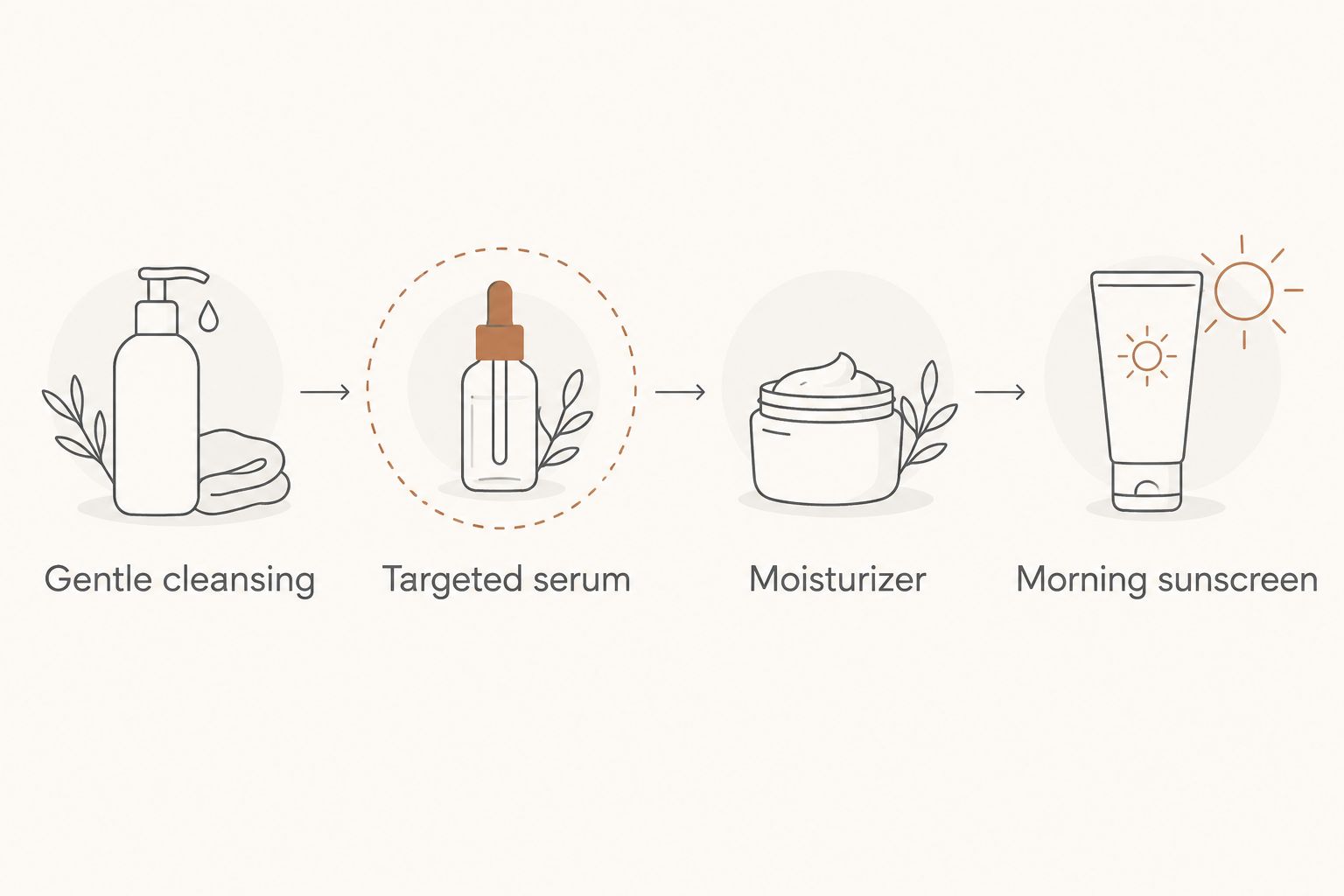
The sequence below separates daily essentials from optional treatment. Follow each product's directions rather than assuming that every serum or cleanser has identical instructions.
- Gentle cleansing: Remove the day's buildup and products without scrubbing. At night, choose a cleansing method appropriate for the sunscreen and makeup you wear.
- Targeted serum: Add a serum only if it addresses a defined concern and fits the rest of your care. Apply according to its directions.
- Moisturizer: Choose a texture that leaves your skin comfortable. A serum does not automatically replace this step.
- Morning sunscreen: Finish morning skincare with sunscreen before makeup. A day cream without a labeled SPF is not your sunscreen step.
Evening care follows the same logic without the sunscreen step. You do not need to repeat every optional morning product at night, and you do not need to double-cleanse simply to make the routine feel complete.
Sensitive-skin note: Introduce new products individually, test a small area before broader use, and stop using a product that causes irritation. Fragrance-free does not guarantee tolerance; persistent or significant symptoms belong with a dermatologist rather than another product experiment.
A Japanese-inspired starting point from Kiyomi Skin
Kiyomi Skin is best for shoppers seeking Japanese-inspired skincare with fragrance-free cleanser and moisturizer options. For a simple starting routine, focus on the cleansing and moisturizing roles before choosing an additional serum.
These two products have fragrance-free descriptions in the current catalog. That supports the specific fragrance-free statements below, not a claim that every product in the range has the same formulation profile.
| Product | Best for | Supported reason to choose it | Boundary to keep in mind |
|---|---|---|---|
| Cleansing Gel | Shoppers who prefer a gently foaming cleanser | Fragrance-free cleansing gel in a 100 ml format | A rinse-off cleanser is not a leave-on moisturizer |
| Day Cream | Shoppers seeking a fragrance-free daily face moisturizer | Contains 5-ALA and hyaluronic acid in a 50 ml format | No SPF is stated in the supplied catalog description; use separate sunscreen |
Choose Cleansing Gel when a gently foaming format matches your preference. Choose Day Cream for the moisturizing step, then apply your separate sunscreen in the morning.


Kiyomi Skin skincare features 5-ALA, short for 5-aminolevulinic acid. Its inclusion identifies an ingredient in the formula; it does not, by itself, establish a finished product's effect on wrinkles, skin sensitivity, or biological aging.
That distinction helps you shop with confidence. Choose these products for their stated cleansing and moisturizing roles, not an assumption that ingredient science proves every possible benefit.
How should you compare skincare claims in 2026?
Ask what was tested before deciding how much weight to give a claim. A study on an isolated ingredient is different from a study on the exact formula you plan to apply.
A useful product study identifies the tested formulation, participants, duration, methods, and results. A comparison group helps distinguish a product's effect from changes that happen during the study for other reasons.
Measurements and opinions also need separate labels. A questionnaire about smoother-feeling skin reports participants' experiences; it is not the same as an instrument measuring skin texture.
Use these questions when comparing either Japanese or Korean products:
- Was the finished product tested, or just an ingredient?
- Does the measured outcome match the advertised benefit?
- Were participants relevant to your concern?
- Is the study duration stated?
- Are the study's limitations explained alongside its results?
National origin cannot answer any of those questions. Neither can an attractive ingredient story.
Is Japanese skincare better for sensitive skin?
Japanese skincare is not automatically better for sensitive skin. A verified fragrance-free formula and a routine that respects your known sensitivities are more useful selection criteria than nationality.
Choose a cleanser and moisturizer first, then evaluate optional products individually. This approach works whether you prefer Japanese skincare, Korean skincare, or a combination.
Is Korean skincare better for hydration and glow?
Korean skincare is not automatically better for hydration and glow. Compare the actual moisturizer or serum, its intended use, and how comfortably it fits your routine.
Hyaluronic acid is a humectant, meaning it helps attract and retain water. Its presence is useful formulation information, but it is not a reason to rank every product containing it above every product without it.
Can you mix Japanese and Korean skincare?
You can combine Japanese and Korean skincare without committing to either category. Choose complementary roles—cleanser, moisturizer, sunscreen, and an optional targeted serum—rather than collecting several products that do the same job.
Check individual directions and ingredient compatibility, especially when adding treatment products. Country of origin is not a compatibility test.
FAQ
What's better for beginners, Japanese or Korean skincare?
Neither Japanese nor Korean skincare is inherently better for beginners. Start with a suitable cleanser, moisturizer, and daily sunscreen, then add a targeted product only when you have a clear reason.
Do I need a long routine to get glowing skin?
A long routine is not required for well-moisturized, comfortable-looking skin. Consistent cleansing, moisturizing, and sun protection provide a practical foundation; additional steps should address a specific need.
Is Japanese skincare always fragrance-free?
Japanese skincare is not always fragrance-free. Verify the individual formula rather than applying a category-wide assumption to cleansers, serums, or creams.
Should sensitive skin always avoid Korean skincare?
Sensitive skin does not require avoiding Korean skincare as a category. Evaluate the complete formula, your known sensitivities, and the product's intended role, just as you would with Japanese skincare.
Does a day cream replace sunscreen?
A day cream does not replace sunscreen unless it provides appropriate labeled sun protection and you use it as directed. The American Academy of Dermatology recommends broad-spectrum, water-resistant sunscreen with SPF 30 or higher.
Is 5-ALA proof that a skincare product works better?
The presence of 5-ALA alone does not prove that a finished skincare product works better. Evidence must match the specific formulation and the benefit being claimed.
What's the best way to choose between Japanese and Korean skincare in 2026?
Choose between Japanese and Korean skincare by comparing formulas, product roles, and evidence—not by assuming one country makes better skincare. Keep products that meet your needs comfortably and remove steps without a clear purpose.
One last thing
The most useful comparison is often between a necessary step and an unnecessary one. Before adding another product in 2026, finish this sentence: this product belongs in my routine because it addresses a need my current products do not.
If the answer is simply that it completes a trend, keep your routine as it is. For a straightforward Japanese-inspired foundation, shop Kiyomi Skin's Cleansing Gel and Day Cream above, then build only where your skin needs more.