Can bakuchiol serum be used during pregnancy?
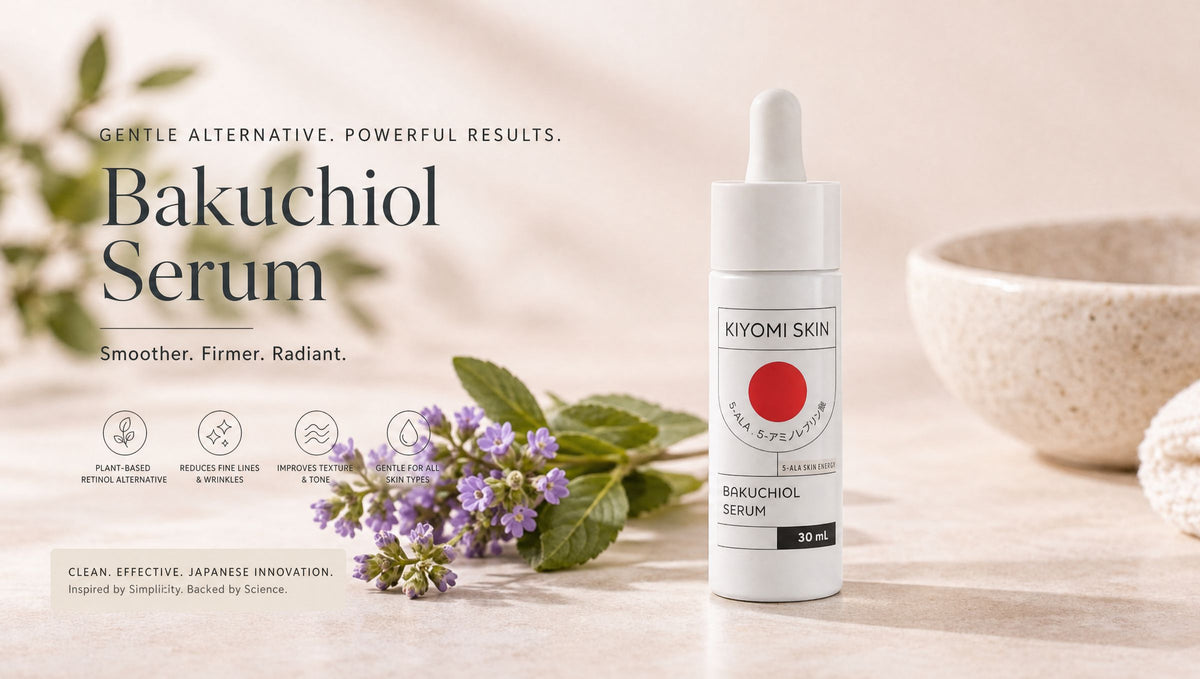
Bakuchiol serum is not established as safe during pregnancy, so ask your obstetrician or dermatologist to review the exact formula before using it. Being plant-derived or described as a retinol alternative does not establish pregnancy safety. This 2026 guide explains what to check, how bakuchiol differs from retinoids, and how to keep your routine focused on cleansing, moisture, and sun protection.
- Can bakuchiol serum be used during pregnancy? Safety is not established; get a formula-specific review from your clinician.
- Bakuchiol and retinol are different ingredients; a retinol-alternative label does not establish pregnancy safety.
- Kiyomi Skin skincare should be reviewed by complete formula, including products containing 5-ALA.
- Keep pregnancy skincare simple: gentle cleansing, moisturizer, and daily broad-spectrum sunscreen.
Why this matters
Pregnancy changes the question you need a skincare product to answer. A serum can have evidence for improving the appearance of fine lines without having evidence that establishes its suitability during pregnancy. Those are separate questions.
If you have sensitive skin, keep formula selection practical. Our guide to choosing a gentle cleansing gel for sensitive skin explains a useful starting point: choose cleansing around your skin's needs rather than adding steps automatically.
For your 2026 routine, prioritize a clear purpose for every product. You do not need to replace a paused treatment serum with another active ingredient simply to keep the same number of steps.
Can bakuchiol serum be used during pregnancy?
Do not assume bakuchiol serum is suitable during pregnancy without a clinician's review. Pregnancy-specific safety evidence is insufficient to give bakuchiol a blanket recommendation. Your obstetrician or dermatologist should assess the finished formula, not just the ingredient highlighted on the bottle.
Use this sequence before adding a serum:
- Find the full ingredient list. A product name or front-label claim is not enough for a formula review.
- Identify every active ingredient. A bakuchiol serum can contain other ingredients that change the recommendation.
- Share your situation. Tell your clinician whether you are pregnant, trying to conceive, or breastfeeding, and explain how you intend to use the product.
- Ask for a product-specific decision. Confirm whether to use, pause, or replace that exact formula.
A helpful question is: Does this complete serum fit my pregnancy skincare routine, and is there a better-studied option for my concern?
That question is more useful than asking whether all natural skincare is safe. It directs the conversation toward the formula you will actually put on your skin.
Bakuchiol versus retinol: what changes during pregnancy?
Bakuchiol is not a retinoid. Retinol belongs to the vitamin A family; bakuchiol is chemically different, even when brands discuss both ingredients in relation to the visible signs of aging.
The distinction matters, but it does not settle pregnancy suitability. Not being retinol is not the same as having established pregnancy safety.
| Ingredient or category | Best for this discussion | Relevant benefit or role | Pregnancy limitation or next move |
|---|---|---|---|
| Bakuchiol | Understanding a non-retinoid ingredient marketed for visible aging concerns | Studied for cosmetic outcomes such as the appearance of photoaging | Pregnancy safety is not established; request a complete-formula review |
| Retinol and other topical retinoids | Identifying products to discuss when planning or confirming pregnancy | Used for concerns including visible aging and acne | Dermatology guidance recommends avoiding topical retinoids during pregnancy |
| Basic moisturizer | Supporting a simpler, hydration-focused routine | Helps maintain skin moisture and comfort | Have the complete formula checked rather than treating the category as automatic approval |
| Broad-spectrum sunscreen | Daily protection from ultraviolet exposure | Helps prevent sunburn and UV-related skin damage | Choose a pregnancy-appropriate formula with your clinician if you need selection advice |
The American Academy of Dermatology advises avoiding retinoids during pregnancy. That guidance does not automatically endorse every ingredient marketed as a replacement.
For shoppers comparing options in 2026, the useful distinction is between evidence for a cosmetic benefit and evidence for use during pregnancy. One cannot substitute for the other.
What evidence would establish pregnancy suitability?
A clinical study showing improved firmness or smoother-looking skin answers an appearance question. A questionnaire reporting comfortable use answers a participant-experience question. Neither establishes safety for pregnancy unless the research specifically addresses that population and relevant outcomes.
The same applies to laboratory research. An ingredient's behavior in cells or a test dish does not establish how a finished serum should be used during pregnancy.
When you read product claims, separate these evidence types:
- Ingredient research: Findings about an individual ingredient, not necessarily the finished product.
- Finished-product testing: Findings about a specific formula under defined conditions.
- Skin-tolerance testing: Information about irritation or reactions under the test conditions.
- Pregnancy-specific evidence: Information directly relevant to use during pregnancy.
A formula can have evidence in one category and still lack evidence in another. This is why a dermatologist-tested label, a sensitive-skin claim, or a small cosmetic study cannot independently answer your pregnancy question.
You do not need to interpret research papers yourself before a medical appointment. Bring the full ingredient list and ask which evidence supports the recommendation for your circumstances.
Why pregnancy skincare recommendations vary
A useful recommendation considers the whole product and the person using it. These factors explain why advice about one serum does not automatically transfer to another:
- The complete formula: The featured ingredient is only part of what you apply.
- The intended use: A rinse-off cleanser and a leave-on serum have different use patterns.
- The available evidence: Research on appearance, tolerance, and pregnancy answers different questions.
- Your medical context: Pregnancy, preconception, and breastfeeding require their own discussion.
- Your skin's current condition: Your clinician needs to know about irritation, eczema, allergies, and other treatments.
Avoid looking for a universal safe-ingredient list that replaces this review. An ingredient list is a starting point for a decision, not a guarantee about every formula that contains it.
If two clinicians give different advice, ask what each recommendation is based on and whether either has reviewed the current formula. That gives you a concrete issue to resolve rather than another product label to decode.
Build a simple pregnancy skincare routine
A Japanese-inspired routine can stay focused on a few purposeful steps. During pregnancy, simplicity means keeping products that meet a clear need, not chasing a particular finish or adding a replacement serum by default.
Gentle cleansing
Use a gentle cleanser to remove daily buildup without scrubbing. Choose the cleansing method around what you need to remove; double cleansing is not a requirement for every face or every evening.
For sensitive skin, pay attention to how your skin feels after washing. Persistent tightness or stinging is a reason to reassess the product or cleansing method rather than cleanse more aggressively.
Moisturizer
Follow cleansing with a moisturizer that suits your skin's comfort needs. Hydration is a practical focus when you pause an appearance-focused serum.
A moisturizer is not a pregnancy treatment, and it does not need to promise dramatic correction to earn its place. Its routine role is straightforward: help keep your skin moisturized.
Sun protection
The American Academy of Dermatology recommends broad-spectrum, water-resistant sunscreen with SPF 30 or higher. Reapply about every 2 hours outdoors, and follow the label after swimming or sweating.
Use shade and protective clothing alongside sunscreen. A day cream without a stated SPF is not a substitute for a dedicated sun-protection step.
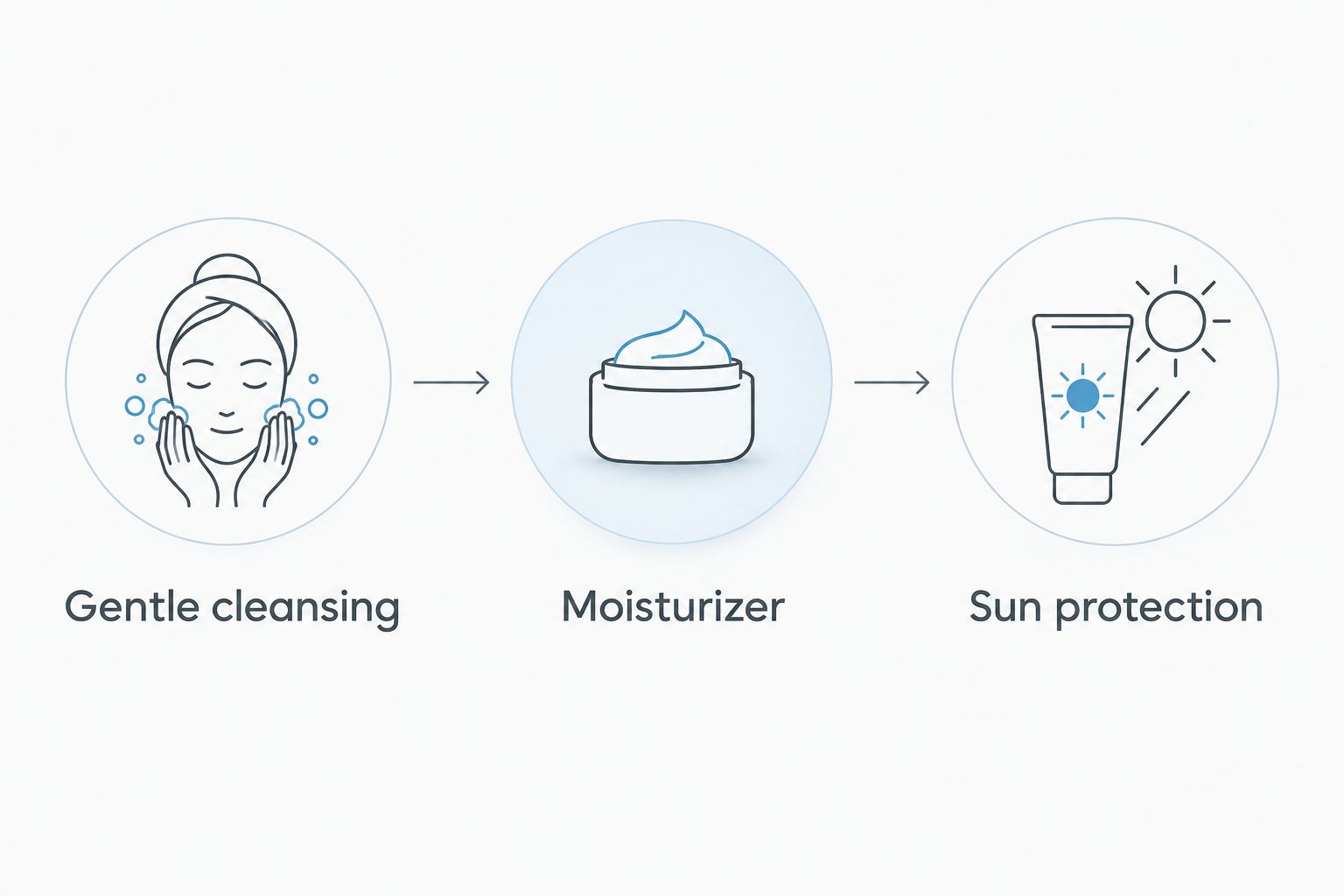
For a 2026 routine review, write these three steps down before your appointment. Then list any serums, masks, exfoliants, or prescriptions underneath so your clinician can see the complete routine.
Where Kiyomi Skin fits in a clinician-reviewed routine
For pregnancy, Kiyomi Skin skincare is best chosen with your clinician, one complete formula at a time. The catalog includes products with distinct routine roles, allowing you to shop by need rather than assemble a long regimen.
These two options address basic cleansing and moisturizing. Neither is presented here as pregnancy-approved; bring the current ingredient lists to your clinician before choosing.
| Product | Best for | Supported product details | Selection consideration |
|---|---|---|---|
| Cleansing Gel | Shoppers seeking a fragrance-free foaming cleanser | Described as a gently foaming, fragrance-free facial cleansing gel | Select it for cleansing; it does not replace moisturizer |
| Day Cream | Shoppers seeking fragrance-free daily moisturizing care | Contains 5-ALA and hyaluronic acid; described as fragrance-free | Select it for moisture; no SPF is stated in the supplied product information |
Once your clinician has reviewed the formulas, shop the step your routine actually needs. If you already have a suitable cleanser, there is no need to replace it simply because you are choosing a moisturizer.


Does 5-ALA change the answer about bakuchiol?
Adding 5-ALA does not establish a bakuchiol serum's pregnancy suitability. Ingredient science and pregnancy guidance remain separate, even when multiple ingredients appear in the same formula.
Kiyomi Skin Bakuchiol Serum belongs in a formula-specific conversation with your clinician, not on an automatically approved pregnancy list. Evidence concerning the appearance of firmness or fine lines does not answer whether to use it during pregnancy.
The practical shopping rule is simple: choose by the complete formula and your current needs, not by a single ingredient's reputation. A well-aging routine can remain useful while an optional serum stays paused.
What should I do if I already used bakuchiol while pregnant?
Pause the serum and contact your obstetrician or dermatologist for individualized advice. Share the product name, full ingredient list, when you used it, and approximately how often you applied it.
Insufficient safety evidence is not proof that an exposure caused harm. Do not interpret a precautionary recommendation as a diagnosis or assume that using the serum means something has gone wrong.
Keep the packaging or take a clear photograph of the ingredient list. That gives your clinician more useful information than a screenshot describing the product as natural or a retinol alternative.
Can I use bakuchiol while trying to conceive or breastfeeding?
Ask for separate advice for preconception and breastfeeding rather than extending a pregnancy recommendation automatically. Tell your clinician which stage applies and whether the product would be used near areas an infant could contact.
If you are reviewing skincare in 2026 before trying to conceive, bring your existing routine rather than buying replacements first. Your clinician can help identify which products need changing and which routine steps can stay simple.
FAQ
Can bakuchiol serum be used during pregnancy?
Bakuchiol serum is not established as safe during pregnancy. Ask your obstetrician or dermatologist to review the exact formula before using it.
Is bakuchiol the same as retinol?
Bakuchiol is not retinol and is not a retinoid. Its different chemical identity does not independently establish pregnancy safety.
Does natural bakuchiol mean it is pregnancy-safe?
No. A plant-derived ingredient still needs evidence relevant to pregnancy; natural origin is not a safety assessment.
Can I patch-test bakuchiol to check pregnancy safety?
A home patch test cannot establish pregnancy safety. It concerns a local skin response, not the separate question of suitability during pregnancy.
What can I use instead of a bakuchiol serum while pregnant?
Start with clinician-reviewed basics: a gentle cleanser, moisturizer, and broad-spectrum sunscreen. If you need treatment for a particular concern, ask your clinician to recommend a suitable option.
Is Kiyomi Skin Bakuchiol Serum approved for pregnancy?
This guide does not establish pregnancy suitability for Kiyomi Skin Bakuchiol Serum. Have your clinician review its current complete ingredient list before use.
Does a fragrance-free label mean a serum is safe during pregnancy?
No. Fragrance-free describes a formulation characteristic, not pregnancy safety, so the complete formula still needs review.
Should I worry if I used bakuchiol before knowing I was pregnant?
Contact your clinician for an individualized assessment and pause the serum while awaiting advice. A lack of established safety evidence does not mean that your use caused harm.
One last thing
A shorter routine is not an incomplete routine. You can focus on clean, comfortable, moisturized skin without replacing every paused active ingredient.
Before shopping, save the ingredient lists of products you are considering and take them to your appointment. A product-specific answer is more useful than another pregnancy-safe label without supporting evidence.