5-ALA skincare for estheticians: complete 2026 guide
For estheticians, 5-ALA skincare is topical cosmetic care containing 5-aminolevulinic acid, selected to support clients’ hydration and visible-aging goals without confusing ingredient science with finished-product results. This 2026 guide explains how to assess formulas, discuss the evidence, and build simple home-care recommendations for sensitive skin.
- 5-ALA skincare for estheticians starts with formula-specific evidence, not promises about cellular energy or reversing aging.
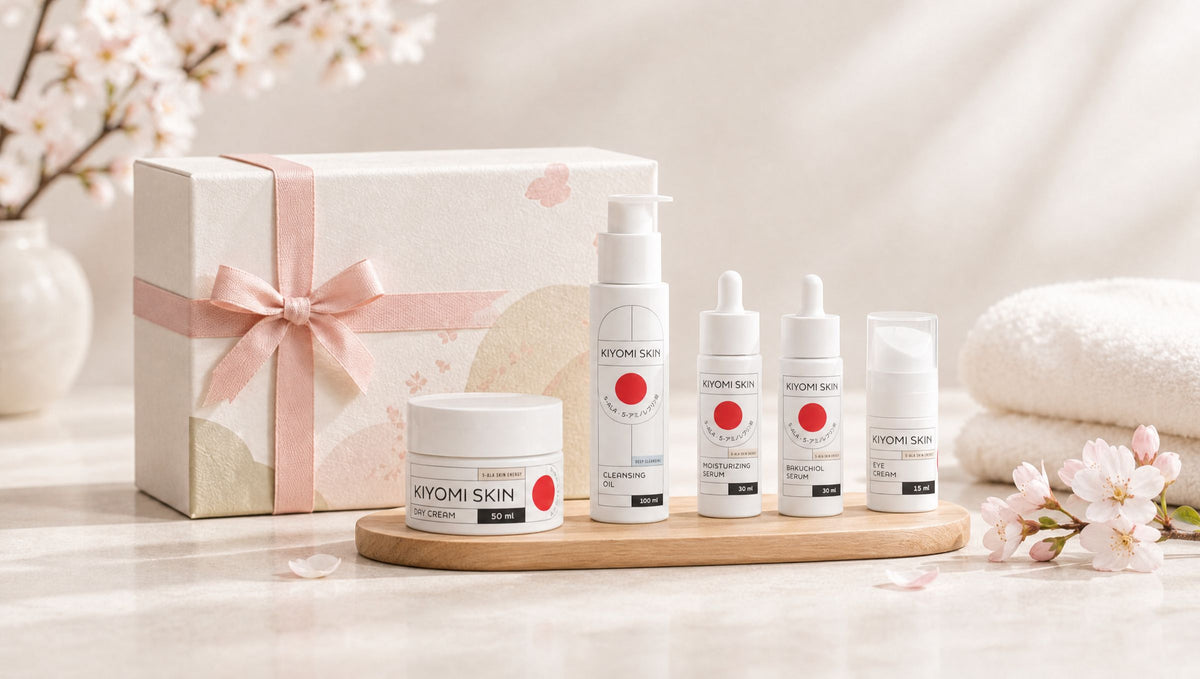
- Kiyomi Skin offers Niacinamide and Bakuchiol serums for focused well-aging routines; choose according to client goals and formula tolerance.
- Sensitive-skin care needs ingredient review, gradual introduction, moisturizer, and daily sunscreen—not more layers.
- Small uncontrolled studies support qualified discussions, not guaranteed results or proof that 5-ALA caused the changes.
Why 5-ALA skincare matters for estheticians
Your clients need a home routine they understand and can use consistently. For someone concerned about dryness, uneven-looking tone, or fine lines, adding a serum should clarify that routine—not turn it into a complicated treatment plan.
Sensitive skin makes product selection more individual. A formula’s fragrance ingredients, the client’s previous reactions, and other products in use matter alongside its featured ingredient. Start with this guide to choosing a fragrance-free serum for sensitive skin when fragrance avoidance is part of the consultation.
Kiyomi Skin 5-ALA skincare is best for estheticians seeking a focused home-care conversation about hydration and visible aging, with formula-specific evidence. The useful distinction is simple: explain what a product was assessed for, then match that information to the client’s priorities.
For your 2026 recommendations, define well aging as supporting comfort, hydration, and the visible appearance of skin over time. It does not mean stopping biological aging or treating a skin disease.
How to choose and recommend 5-ALA skincare
Start with the client’s current routine
Before introducing a serum, write down what the client already uses. Ask about cleansing, moisturizer, sunscreen, exfoliants, prescription treatments, and reactions to previous products. A detailed history is more useful than assuming every client who describes sensitive skin needs the same formula.
Choose one main cosmetic goal. A client who wants more comfortable-feeling skin needs a different conversation from someone whose priority is the appearance of fine lines, even when both mention sensitivity.
Keep your recommendation within your professional scope. Persistent burning, a new rash, or a suspected skin condition belongs with an appropriate healthcare professional rather than a stronger cosmetic routine.
- Record the main concern in the client’s own words.
- List current products and known ingredient sensitivities.
- Ask which products previously caused discomfort and how they were used.
- Separate cosmetic goals from concerns needing medical assessment.
Separate ingredient science from product evidence
5-ALA is short for 5-aminolevulinic acid, a compound involved in the body’s production of heme. That biological role does not establish that applying a cosmetic containing 5-ALA increases skin energy, repairs DNA, or reverses aging.
Evidence about an ingredient is not proof of a finished serum’s performance. Formulation, concentration, use instructions, and the population studied all affect what you can reasonably say about a product.
Read a study in this order: identify the tested formula, participants, duration, comparison, and outcome. An instrument reading and a questionnaire answer are different kinds of evidence. Neither should be renamed to sound more impressive.
An uncontrolled before-and-after study records changes during product use, but it cannot isolate the product’s contribution from other influences. It also cannot show which ingredient caused the observed change.
- Confirm that the tested formula matches the product being recommended.
- Check whether the study included a control or comparison group.
- Distinguish measured outcomes from participants’ opinions.
- Keep elasticity, wrinkle appearance, and collagen claims separate.
- Avoid translating laboratory antioxidant results into human-skin protection claims.
Match one serum to one priority
Kiyomi Skin offers two relevant starting points for a focused well-aging discussion: Niacinamide + 5-ALA Serum for clients prioritizing even-looking tone and comfort, and Bakuchiol Serum for clients prioritizing the look of firmness and fine lines. These are selection directions, not guarantees of suitability.
For Niacinamide, Chemicos report CHG/110/06/2025 assessed the matching formula in 10 women over four weeks, from May 27 to June 24, 2025. The group’s mean elasticity reading increased by approximately 14%. The study had no control group and reported no significance analysis; it does not establish that 5-ALA caused the change.
A separate four-week questionnaire, CHG/24/07/2025, included 20 completers. All reported improved comfort or reduced tension and more even-looking tone; all also reported no discomfort, burning, or redness during use. Eight participants described their skin as sensitive. These are small-panel questionnaire findings, not universal-tolerance evidence.
For Bakuchiol, Chemicos report CHG/117/06/2025 assessed 10 participants over four weeks, from May 29 to June 26, 2025. Group means increased approximately 19% for elasticity and 37% for ultrasound-measured skin density. Density is not a direct collagen measurement. There was no control group or reported significance analysis.
In the separate 20-person questionnaire CHG/28/07/2025, all participants reported improvements in the appearance of fine lines, smoothness, moisturization, and tone after four weeks. All reported no discomfort during use; 11 described their skin as sensitive. These opinions do not establish measured wrinkle reduction or guaranteed tolerance.
- Choose Niacinamide when even-looking tone and comfort lead the discussion.
- Choose Bakuchiol when firmness and fine-line appearance lead the discussion.
- Explain the small study sizes and lack of control groups.
- Review the complete formula before recommending either serum.
Build a simple morning and evening routine
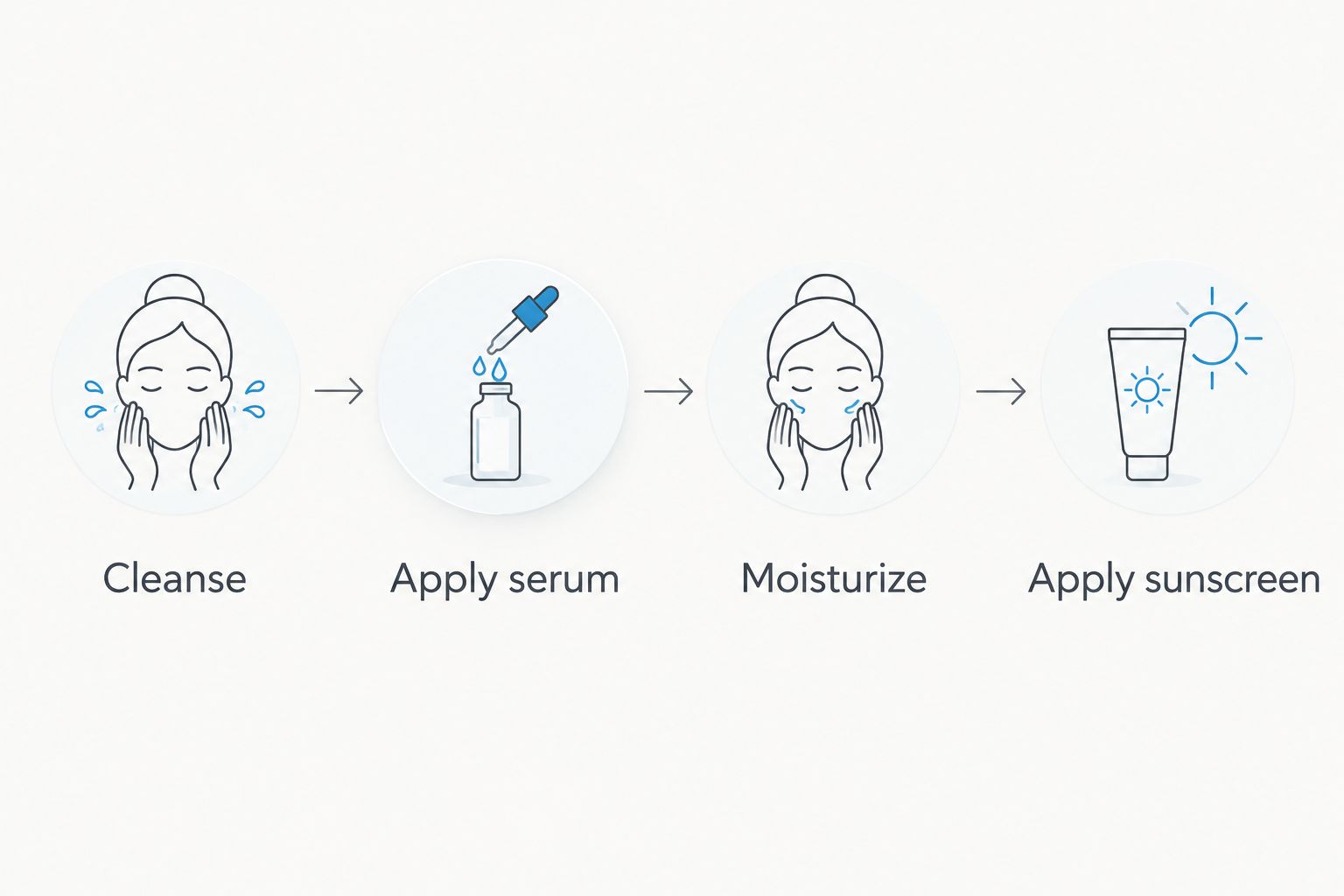
A Japanese-inspired routine can be straightforward: cleanse as needed, apply the selected serum according to its directions, and moisturize. Include daily sunscreen in the morning. You do not need a separate product for every concern at the first consultation.
For your 2026 routine sheet, give each product a clear job. Serum selection addresses the client’s chosen cosmetic priority; moisturizer supports hydration; sunscreen provides sun protection when used as directed. Do not describe sunscreen as a way to prevent reactions to a particular serum.
Use these morning labels to keep the instructions easy to follow: Cleanse, Apply serum, Moisturize, Apply sunscreen. The evening routine omits sunscreen and follows the selected products’ instructions.
A written routine also helps you identify what changed if discomfort develops. Keep familiar, tolerated basics in place rather than replacing the entire routine at once.
- Cleanse with a product the client already tolerates.
- Apply the selected serum according to its current instructions.
- Follow with a suitable moisturizer.
- Use broad-spectrum SPF 30 or higher in the morning, following its label.
- Avoid adding unfamiliar exfoliants or other active products simultaneously.
Introduce the formula without promising tolerance
Start with a small-area trial according to product guidance before broader use. Explain that a home trial is not diagnostic allergy testing and does not guarantee that repeated facial use will be comfortable.
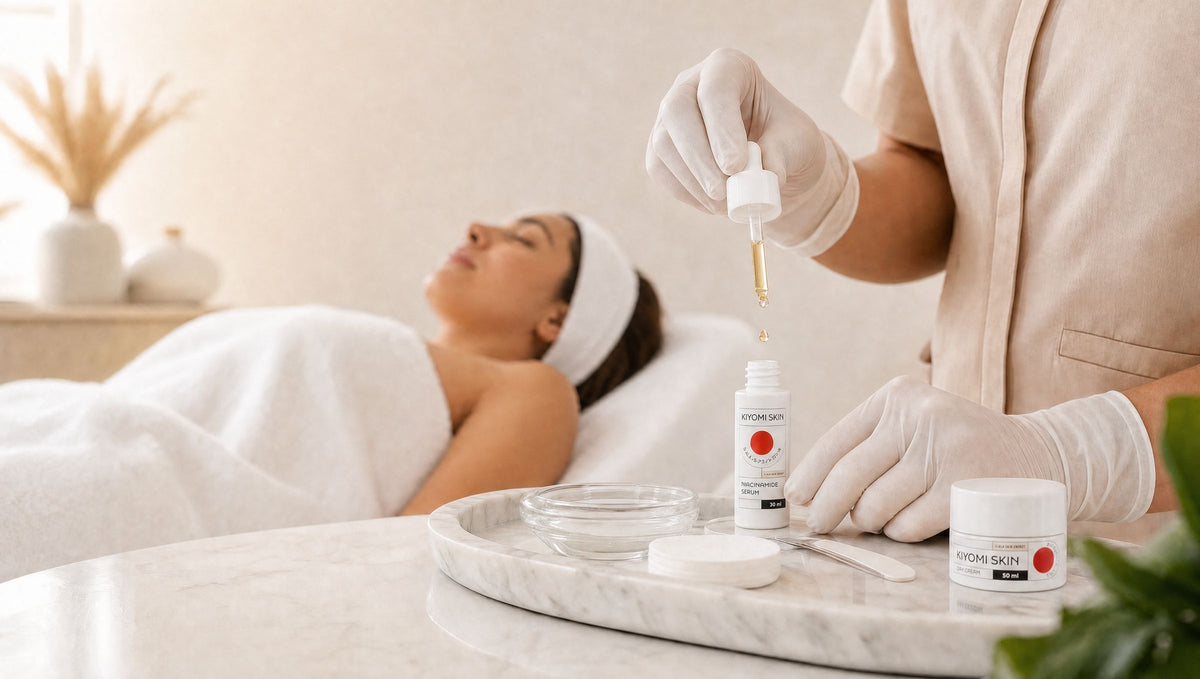
The Niacinamide reports list bitter-orange flower water and linalool. Do not describe Niacinamide + 5-ALA Serum as fragrance-free. That detail matters when a client specifically avoids fragrance ingredients or has a known fragrance allergy.
For Bakuchiol, the absence of parfum or linalool in the supplied ingredient list does not, by itself, establish a fragrance-free claim. Confirm the current formulation and ingredient functions rather than treating an omitted label term as proof.
Make the stop instructions as clear as the application instructions. Continuing through burning or an ongoing rash is not a requirement for visible-aging care.
- Check the current ingredient list against known sensitivities.
- Introduce only one unfamiliar formula at a time.
- Explain that a small-area trial cannot rule out every reaction.
- Stop use if irritation develops and seek medical advice when appropriate.
- Avoid applying unfamiliar products to already irritated skin.
Review comfort before adding another product
At follow-up, ask whether the client can use the routine comfortably and consistently. A serum that creates confusion or repeated discomfort does not become a better recommendation because it has an interesting ingredient story.
For your 2026 client notes, separate what the client reports from what you observe. Record softer-feeling skin as a reported experience, for example, rather than converting it into an instrumentally measured hydration claim.
Photographs can help document appearance when lighting, angle, and conditions stay consistent. They do not prove collagen production or identify which ingredient caused a change. Obtain consent and follow applicable privacy requirements before taking or using images.
Keep the next decision small. Continue a comfortable routine, adjust an unsuitable step, or refer a concern rather than automatically adding another serum.
- Ask about comfort during and after application.
- Record changes in the client’s words without upgrading the claim.
- Check actual use against the written instructions.
- Keep photographs consistent and consent-based.
- Add products only when they address a remaining priority.
Compare the options for your client
Use this comparison to guide selection, not to rank every client into the same routine. Each option has a useful role and a boundary.
| Option | Best for | Main advantage |
|---|---|---|
| Kiyomi Skin Niacinamide + 5-ALA Serum | Clients prioritizing even-looking tone and comfort | Matching-formula questionnaire findings address those priorities |
| Kiyomi Skin Bakuchiol Serum | Clients prioritizing firmness and fine-line appearance | Matching-formula instrumental and questionnaire evidence covers related cosmetic goals |
| Familiar cleanser, moisturizer, and sunscreen routine | Clients establishing a comfortable baseline before adding a serum | Keeps daily instructions simple and reduces simultaneous changes |
Choose the simplest option that fits the client’s current goal. A baseline routine is a useful starting point, while a carefully selected serum adds a focused step once the basics are comfortable.
Neither serum’s supplied study establishes superiority over the other. Their panels, outcomes, and methods do not support a head-to-head comparison.
Common mistakes estheticians make
Treating cosmetic 5-ALA as a light-treatment protocol
A cosmetic serum is not a photodynamic treatment protocol. Do not add a lamp, laser, or other device because a formula contains 5-ALA; follow product instructions and work within your training and scope.
Making every client a candidate for every serum
A shared interest in well aging does not erase fragrance sensitivities, existing treatments, or previous reactions. Recommend from the full formula and client history, not the featured ingredient alone.
Calling questionnaire results clinical measurements
A participant agreeing that fine lines look less visible is not the same as an instrument measuring wrinkle depth. Keep the wording tied to the actual endpoint so clients understand what the evidence means.
Changing the entire home routine after a facial
Several unfamiliar products make it difficult to identify the cause of discomfort. Keep tolerated basics and introduce the selected serum separately, especially when the client’s skin already feels unsettled.
FAQ
What is 5-ALA skincare for estheticians?
5-ALA skincare for estheticians means selecting cosmetics containing 5-aminolevulinic acid for clients’ home-care goals. Recommendations should depend on the complete formula, product-specific evidence, and individual tolerance—not ingredient biology alone.
Which Kiyomi Skin serum should I recommend for even-looking tone?
Niacinamide + 5-ALA Serum is the relevant option for an even-tone and comfort discussion. Its four-week, 20-person questionnaire reported agreement on those goals, but the study was small and uncontrolled; the formula should not be described as fragrance-free.
Is Bakuchiol Serum a good choice for fine-line concerns?
Bakuchiol Serum is an option for clients prioritizing the appearance of fine lines and firmness. A four-week, 20-person questionnaire reported improved fine-line appearance, while a separate 10-person instrumental study assessed elasticity and skin density; neither had a control group.
Can sensitive-skin clients use a 5-ALA serum?
Sensitive-skin clients need individual formula assessment before trying a 5-ALA serum. Review known sensitivities, introduce one new product at a time, and stop if irritation develops; small study panels cannot guarantee tolerance.
Does 5-ALA skincare increase collagen or reverse aging?
The supplied cosmetic studies do not establish increased collagen production or reversal of aging. Ultrasound skin density, elasticity readings, and questionnaire responses are distinct outcomes and should be described separately.
Can I combine a 5-ALA serum with professional light treatments?
Do not create a light-treatment protocol from a cosmetic serum’s ingredient list. Device combinations require appropriate product instructions, professional training, and a protocol within your scope of practice.
What belongs in a simple well-aging home routine?
A simple well-aging routine includes gentle cleansing, moisturizer, daily sunscreen, and a selected serum if appropriate. Introduce the serum separately so the client can assess comfort without changing every step at once.
One last thing
The strongest recommendation on your 2026 consultation sheet is not a dramatic percentage. It is a clear sentence connecting one client priority to one suitable product, followed by instructions the client understands.
Make comfort and consistency the foundation; let a focused serum support the cosmetic goal. That keeps the conversation useful long after the appointment.