Is bakuchiol as effective as retinol?
Bakuchiol can improve the appearance of wrinkles and uneven pigmentation, but the evidence does not establish that it is as effective as retinol across products and uses. A small head-to-head trial found improvements with both ingredients and more scaling and stinging with retinol; in 2026, that supports bakuchiol as an option, not a proven equivalent.
- Is bakuchiol as effective as retinol? Early comparative results are encouraging, but equal effectiveness is not established.
- Retinol is best for shoppers prioritizing a longer research history; bakuchiol offers an alternative when retinol feels uncomfortable.
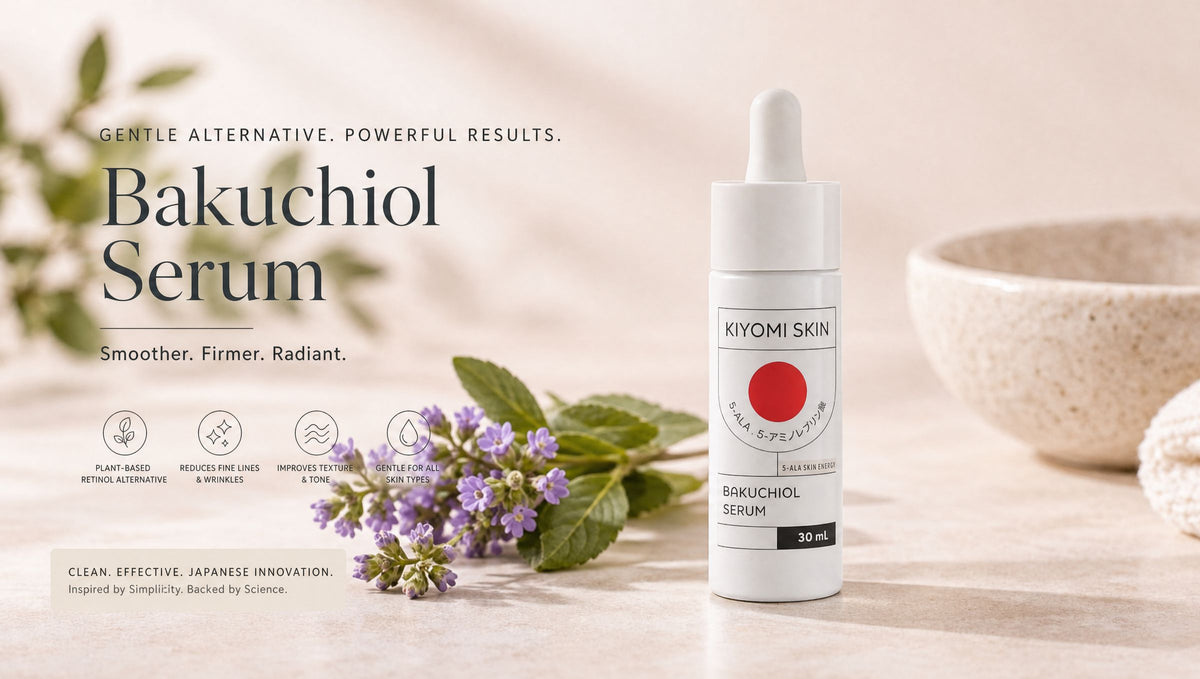
- Kiyomi Skin Bakuchiol Serum contains 3% bakuchiol for a focused fine-line and firmness routine.
- Choose the finished formula, not just the ingredient: concentration, supporting ingredients, and consistent use all matter.
For sensitive skin, ingredient choice is only part of the decision. Start with the complete formula and our guide to choosing a fragrance-free serum for sensitive skin, rather than treating a botanical ingredient as an automatic guarantee of gentleness.
Is bakuchiol as effective as retinol?
Bakuchiol has promising comparative evidence, but it has not been established as interchangeable with retinol. The clearest direct comparison is a randomized, double-blind study by Dhaliwal and colleagues, published in the British Journal of Dermatology in February 2019.
The study involved 44 participants over 12 weeks. Participants applied either a 0.5% bakuchiol cream twice daily or a 0.5% retinol cream once daily. Both groups showed reductions in wrinkle surface area and hyperpigmentation, with no statistically significant difference between groups on those outcomes.
That result needs its full context. The application schedules differed, the study was small, and finding no statistically significant difference does not prove that two ingredients are equivalent.
| Question | Bakuchiol | Retinol |
|---|---|---|
| Best for | Shoppers considering an alternative when retinol feels uncomfortable | Shoppers prioritizing an ingredient with a longer research history |
| Main advantage | Encouraging evidence for visible wrinkles and uneven pigmentation | A more established body of research on visible photoaging |
| Main limitation | Fewer clinical studies and less certainty across formulations | Irritation can interrupt consistent use |
| Head-to-head study | 0.5% cream, twice daily, for 12 weeks | 0.5% cream, once daily, for 12 weeks |
| Tolerance in that study | Less scaling and stinging than the retinol group | More scaling and stinging than the bakuchiol group |
| What the comparison cannot establish | That every bakuchiol serum matches retinol | That every retinol formula performs like the tested cream |
The practical answer in 2026 is straightforward: choose retinol for its more established evidence base, or consider bakuchiol when you want an alternative that better fits your routine. Neither choice removes the need to assess the actual product.
Why this matters for sensitive skin
A serum only helps your routine if you can use it consistently. Choosing the most familiar active ingredient is not useful if the formula repeatedly leaves your skin uncomfortable and you stop using it.
Sensitive skin also changes the question. Instead of asking only which ingredient delivers the strongest visible change, ask which finished formula fits your goals, your existing moisturizer, and your skin's response.
That is the purpose of a well-aging routine: support hydration, comfort, and the visible appearance of aging through repeatable habits. It is not a promise to stop or reverse aging, and it does not require adding every active ingredient at once.
Bakuchiol: best for a retinol alternative
Bakuchiol is not a retinoid, the vitamin A-related ingredient family that includes retinol. It is a different compound studied for some overlapping cosmetic outcomes, including the appearance of wrinkles and uneven pigmentation.
The distinction matters. Calling bakuchiol a “retinol alternative” describes its possible place in a routine; it does not mean the ingredients have identical biology, evidence, or results.
Best for: shoppers who want to explore care for visible aging without choosing retinol. The advantage is another route to a consistent serum routine; the trade-off is a smaller research base, particularly when comparing different finished products.
For your 2026 shopping shortlist, look beyond the front-label ingredient. Check the directions, full ingredient list, and whether any supporting evidence concerns the actual serum rather than bakuchiol in a different cream.
Retinol: best for an established research history
Retinol is a vitamin A derivative used in cosmetic skincare for visible signs of photoaging, including fine lines and uneven pigmentation. It has been studied more extensively than bakuchiol, although the evidence still varies by formulation and study design.
Best for: shoppers who prioritize that longer evidence history and can maintain a comfortable routine. Its main trade-off is irritation, including dryness, scaling, or stinging, which can make regular use difficult.
Do not extend the comparison to prescription tretinoin. Retinol and tretinoin are different ingredients, and the bakuchiol-versus-retinol trial does not establish how bakuchiol compares with prescription treatment.
If your current retinol routine is comfortable and suits your goals, this research alone is not a reason to replace it. If comfort is the obstacle, bakuchiol is an option to evaluate rather than a downgrade to dismiss.
Why results vary between bakuchiol and retinol
The ingredient name is a starting point, not a forecast. These factors explain why the result from one study does not automatically describe the serum on your bathroom shelf:
- Finished formula: A cream and a serum have different supporting ingredients. The complete formulation influences both use experience and performance.
- Concentration: The direct trial tested 0.5% of each ingredient. That does not establish a conversion rule between other strengths.
- Application schedule: Bakuchiol was used twice daily and retinol once daily in the comparative trial. Equal percentages did not mean equal schedules.
- Outcome measured: Wrinkle surface area, pigmentation, elasticity, and questionnaire responses answer different questions. They are not interchangeable measures.
- Study duration: A 12-week comparison describes that observation period, not every later stage of use.
- Consistency and comfort: A product you repeatedly stop using does not reproduce a study's planned application schedule.
When you compare products in 2026, prioritize evidence that matches your concern. A firmness measurement cannot automatically substantiate a wrinkle claim, just as a shopper's report of smoother-feeling skin is not an instrument measurement.
Where Kiyomi Skin Bakuchiol Serum fits
Kiyomi Skin Bakuchiol Serum contains 3% bakuchiol and is best for shoppers building a focused fine-line and firmness routine. The Bakuchiol Serum brings that concentration into a single targeted serum step.
This is a different finished formula from the 0.5% bakuchiol cream used in the retinol comparison. Its 3% concentration is a product feature, not proof of greater effectiveness or equivalence to retinol; the product-specific results below describe what was observed with Kiyomi Skin's formula.
The client-confirmed current US formula was evaluated in Chemicos report CHG/117/06/2025, conducted from May 29 to June 26, 2025. In that uncontrolled, four-week instrumental study of 10 participants, measured elasticity/firmness increased by 19% and ultrasound-measured skin density increased by 37%, using the report's rounded changes in group means.
Those findings support a qualified discussion of the tested formula's measured firmness and density outcomes. They do not demonstrate 37% more collagen or directly measured wrinkle reduction. There was no control group or reported statistical significance analysis, and the study cannot identify bakuchiol or 5-ALA as the specific cause of the changes.
A separate four-week home-use report, CHG/28/07/2025, included 20 participants. All 20 agreed that the product helped reduce the appearance of fine lines and wrinkles, improved smoothness, moisturized, and promoted even tone; these were questionnaire responses, not instrumentally measured wrinkle or hydration changes.
All 20 also reported no discomfort, burning, redness, or similar sensations during that test. This small panel's experience does not establish universal tolerance, and neither report compared the serum with retinol.
Choose a serum and moisturizer with distinct jobs
Keep the serum focused on your visible-aging goal and use a moisturizer for the hydration step. Day Cream contains 5-ALA and hyaluronic acid and is described in the catalog as fragrance-free.
The benefit of this pairing is simplicity: one targeted serum and a separate moisturizing step. Its limitation is equally practical—neither product replaces sunscreen, and adding more layers does not establish better results.
| Product | Best for | Role in your routine | Selection consideration |
|---|---|---|---|
| Bakuchiol Serum | A focused fine-line and firmness routine | Your targeted serum step | Its small product studies did not compare it with retinol |
| Day Cream | A fragrance-free moisturizing step | Hydration after your serum | A moisturizer is not a substitute for sunscreen |
Shop Kiyomi Skin's serum and moisturizer below to build a focused routine rather than a crowded shelf.


How do you build a simple bakuchiol routine?
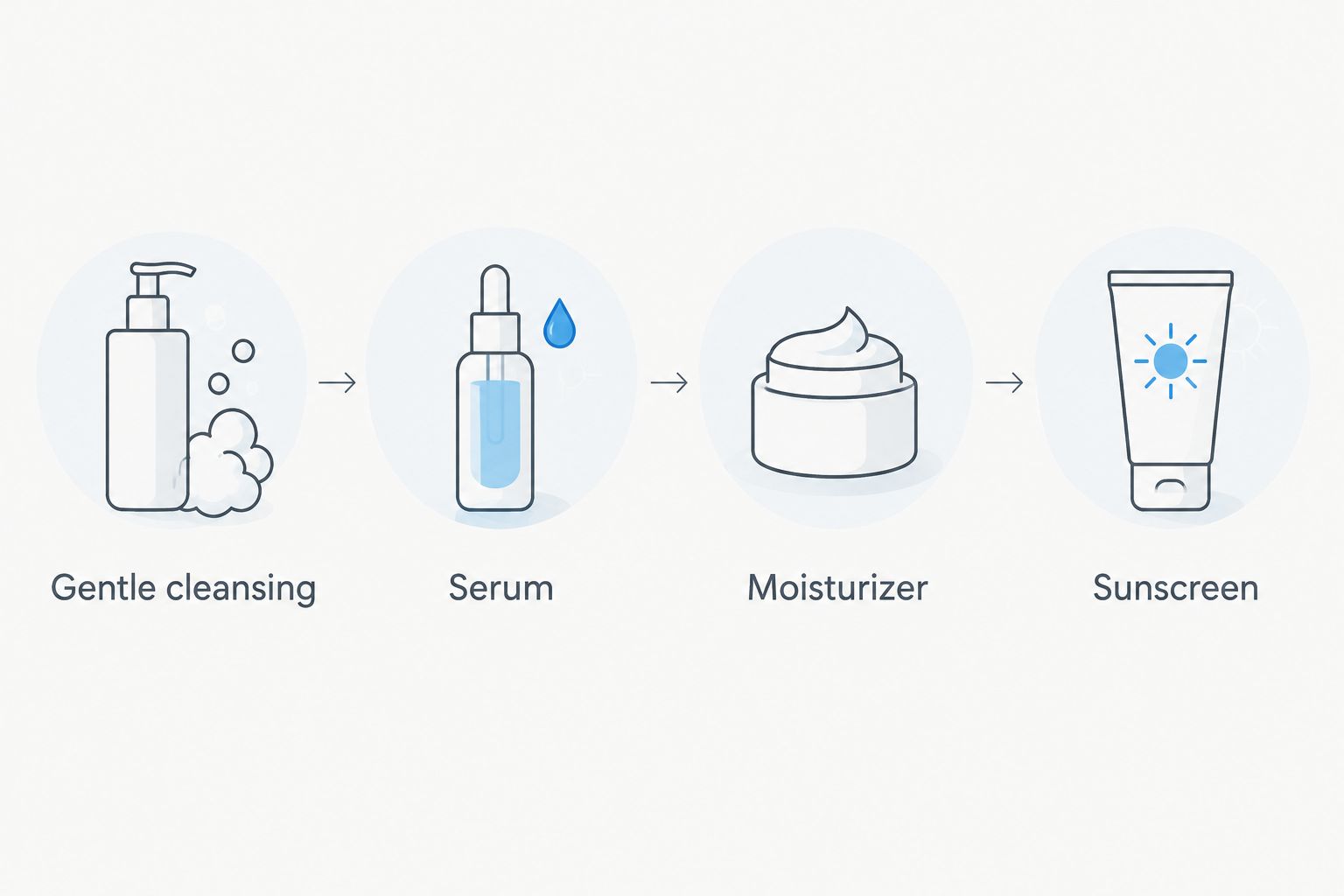
Build your 2026 routine around a few clear jobs: cleansing, targeted serum care, moisturizing, and daytime sun protection. Follow each product's directions rather than copying the application schedule from a study of a different formula.
- Gentle cleansing: Remove the day's buildup with a cleanser that leaves your skin comfortable. A second cleanse is not automatically necessary for every routine.
- Serum: Apply your chosen serum according to its label. Introduce one new treatment at a time so you can identify what suits you.
- Moisturizer: Follow with a moisturizer selected for your skin's needs. Keep this step consistent rather than changing several products together.
- Sunscreen: Finish your morning routine with broad-spectrum SPF 30 or higher. Follow the sunscreen's directions for application and reapplication.
Sensitive-skin note: Try a new product on a small area first, introduce it gradually according to its directions, and stop if irritation develops. Persistent burning, swelling, or a worsening rash needs medical advice; a home trial cannot guarantee that later use will be comfortable.
Take progress photos under similar lighting if you want to compare your skin's appearance over time. Keep expectations tied to the outcome you are tracking, not a general promise of younger skin.
Does bakuchiol work faster than retinol?
The 12-week comparative study does not establish that bakuchiol works faster than retinol. Its results support improvement over the study period, not a universal timetable for visible change.
A four-week product questionnaire also cannot settle that comparison. It describes responses to that particular formula and does not tell you when another product will produce the same experience.
Is bakuchiol better than retinol for sensitive skin?
The 44-participant trial found less scaling and stinging with bakuchiol, but it did not prove that every sensitive-skin shopper will tolerate every bakuchiol formula. Treat that finding as a reason to consider the option, not as a guarantee attached to the ingredient name.
The useful comparison is between complete formulas you can realistically use. Your existing routine and response matter alongside the research.
Can you use bakuchiol and retinol together?
You do not need both to build a useful well-aging routine. For sensitive skin, start with one targeted serum and establish a consistent routine before considering additional treatment steps.
The comparative study tested bakuchiol and retinol separately. It does not demonstrate that combining them delivers better results or better tolerance.
FAQ
Is bakuchiol as effective as retinol for wrinkles?
Bakuchiol showed encouraging wrinkle results alongside retinol in a small 12-week trial, but equal effectiveness is not established. The study used different application schedules and does not settle how all finished products compare.
What's the best choice if retinol makes my skin uncomfortable?
Bakuchiol is an option to consider when retinol feels uncomfortable. Choose the complete formula and maintain a simple moisturizing routine rather than assuming the ingredient guarantees tolerance.
How long should I use bakuchiol before judging the results?
The direct bakuchiol-versus-retinol trial followed participants for 12 weeks. That is a research timeframe, not a guaranteed results deadline for your product; follow its directions and assess your own experience.
Is a higher percentage of bakuchiol always better?
A higher percentage does not by itself establish a better product. The direct comparison tested 0.5% bakuchiol, and its results do not rank other concentrations or formulations.
Does Kiyomi Skin Bakuchiol Serum have product-specific research?
The client-confirmed current US formula has a four-week instrumental study of 10 participants and a separate four-week questionnaire study of 20 participants. Neither had a control group or established equivalence to retinol.
Does bakuchiol replace sunscreen?
Bakuchiol does not replace sunscreen. Use broad-spectrum SPF 30 or higher as part of your morning routine and follow the sunscreen's application directions.
Is bakuchiol the same as prescription tretinoin?
Bakuchiol is not the same as prescription tretinoin. The small comparison with cosmetic retinol does not establish equivalent effects to prescription treatment.
One last thing
Matching percentages do not mean matching treatments. The best-known comparison used 0.5% bakuchiol twice daily and 0.5% retinol once daily, so the front-label number alone cannot tell you which product is stronger or better for your skin.
Choose the routine you can sustain: a targeted serum, dependable moisture, and daily sunscreen. That is a more useful well-aging plan than repeatedly switching ingredients in search of a guaranteed winner.